Tuesday, September 5, 2017
Input on Proposed FY 2019 Transportation Alternatives Projects
FABB encourages members to attend a Fairfax County public meeting on September 14, 2017, where county staff will be soliciting comments on the proposed FY 2019 Transportation Alternatives Projects. The meeting starts at 7 p.m. at the Fairfax County Department of Transportation, 4050 Legato Road, Suite 400, Fairfax, VA 22033. At the meeting, a presentation about the program will be given, followed by a question-and-answer session.
After approval by the Fairfax County Board of Supervisors, the program’s projects will be eligible for submission to the Virginia Department of Transportation (VDOT) for funding under the Fixing America's Surface Transportation Act, also known as the FAST Act. This program provides 80 percent of the funds for each eligible project. A 20 percent local match is required. Any project presented to the board for endorsement must have an identified source of funding for this match.
Activities or improvements eligible under the FAST Act Transportation Alternatives provision that FABB will be promoting include:
- Construction, planning, and design of on-road and off-road trail facilities for pedestrians, bicyclists, and other non-motorized forms of transportation. These include sidewalks, bicycle infrastructure, pedestrian and bicycle signals, traffic calming techniques, lighting and other safety-related infrastructure, and transportation projects to achieve compliance with the Americans with Disabilities Act of 1990.
- Conversion and use of abandoned railroad corridors for trails for pedestrians, bicyclists, or other non-motorized transportation users.
FABB also will be advocating for these activities covered by the FAST Act:
- Infrastructure-related projects-planning, design, and construction of infrastructure-related projects on any public road or any bicycle or pedestrian pathway or trail in the vicinity of schools that will substantially improve the ability of students to walk and bicycle to school.
- These projects can include sidewalk improvements, traffic calming and speed reduction improvements, pedestrian and bicycle crossing improvements, on-street bicycle facilities, off-street bicycle and pedestrian facilities, secure bicycle parking facilities, and traffic diversion improvements in the vicinity of schools.
Non-infrastructure-related activities to encourage walking and bicycling to school also are allowed under the FAST Act and FABB will be encouraging the county to consider pursuing some of these activities, such as public awareness campaigns and outreach to press and community leaders, traffic education and enforcement in the vicinity of schools and student sessions on bicycle and pedestrian safety, health, and environment. The act also provides funding for training, volunteers, and managers of safe routes to school programs, including a Safe Routes to School coordinator, for which FABB has been a longstanding advocate.
For more information on the proposed program or to request reasonable ADA accommodations, contact the Fairfax County Department of Transportation at 703-877-5725, TTY 711.
Labels: fast act, FCDOT, transportation alternatives
posted by Steve Ward at 6:00 AM permalink
(0) comments
Monday, November 2, 2015
Nov-Dec 2015 FABB Newsletter
November-December 2015 FABB News
A bi-monthly publication of Fairfax Advocates for Better Bicycling
Board of Supervisors and School Board Candidate Survey Responses
On November 3, all members and the Chairman of the Fairfax County Board of Supervisors are up for re-election as are all members of the county School Board. FABB recently sent questions regarding bicycling in Fairfax County to candidates for the Board of Supervisors and a separate set to candidates for the School Board. We received responses from 12 of 19 Board of Supervisors candidates and 19 of 24 School Board candidates.
All Board of Supervisors candidates who responded agreed with the statement "Do you support safe bicycling as an integral part of the overall transportation options in Fairfax County." Three quarters or 75% of respondents said they support implementing the Bicycle Master Plan recommendation to "Allocate an annual budget dedicated to bicycle planning and program initiatives." All School Board candidates who responded to the survey generally agreed with the statement "The school system and school board should be doing more to enable FCPS students to walk and bike to school instead of driving or being driven."
FABB does not endorse candidates. We provide the information so that you can better understand candidates' views on improving bicycling in Fairfax.
Extension of Custis Trail Included in I-66 Outside the Beltway Project
 On October 27, the Virginia Commonwealth Transportation Board approved the latest plans for the widening of I-66 Outside the Beltway. The plans include the parallel trail that will serve as an extension of the very popular Custis Trail, which is located inside the Beltway. The rebuilt bridges also will include new ped/bike facilities. We are very encouraged that the parallel trail is now included as an integral part of the project and that most of the ramp crossings are grade-separated using either bridges or tunnels.
Unfortunately much of the trail is located on the highway side of the soundwalls, mostly due to opposition from residents living adjacent to I-66, particularly in the Dunn Loring area. As the project moves forward we hope residents will begin to understand the major benefits of having access to this trail and that the final design will be modified to reflect that support.
Adam Lind Named as New Fairfax County Bike Coordinator
 Fairfax County recently named Adam Lind as the new Bicycle Program Manager, commonly referred to as the Bike Coordinator. Adam has been serving as the acting Bike Coordinator since Charlie Strunk retired in January of this year. Congratulations Adam!
Adam has done a great job as acting coordinator, working with VDOT on the creation of more than 34 miles of new bike lanes as part of this summer's repaving program. The work included conducting numerous meetings around the county to seek comments on individual projects. He is developing a plan to implement bike sharing in Reston. Most recently he has worked with VDOT on the design of the I-66 parallel trail and other bike facilities related to the project.
Soapstone Connector Across Dulles Toll Road in Reston to Provide New Bike Access
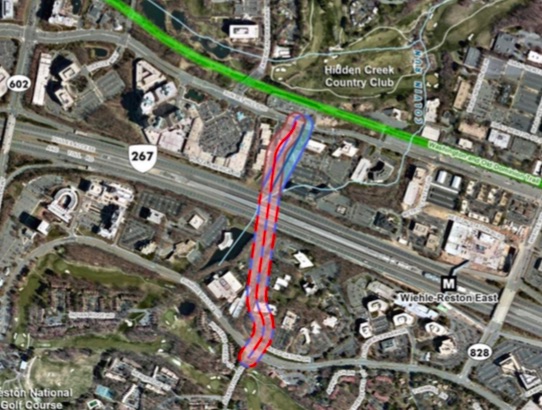 Last week Fairfax County presented the latest plans for the Soapstone Connector, which will extend Soapstone Drive from Sunrise Valley Drive to Sunset Hills Road across the Dulles Toll Road. With limited crossings of the Toll Road, intersections around the Reston Parkway and Wiehle Ave. crossings become very congested during rush hour, making them especially dangerous for pedestrians and bicyclists. The Soapstone Connector will provide a new way for cyclists and pedestrians to safely cross the Toll Road and access the Wiehle-Reston East Metrorail station and other destinations on both sides of the Toll Road. Bike lanes are included in the project and serve as an extension of the current bike lanes on Soapstone Dr.
Unfortunately the proposed road will extend only to Sunset Hills Road on the north where no bike facilities exist. The W&OD Trail is located a short distance north of Sunset Hills Road but there are no nearby connections to the Trail. Please contact the county and ask that a connection to the W&OD Trail be included in the project. Deadline for comments is November 6. Email comments to audra.bandy@fairfaxcounty.gov.
Support the Proposal for Paving Cross County Trail in Wakefield Park
Fairfax Co. Park Authority has proposed to pave a section of the Cross County Trail through Wakefield Park. The trail is heavily used by commuter and recreational cyclists. The unpaved trail is in poor condition and is difficult for most transportation bikers to navigate. A paved surface will be easier to maintain and would provide a much better surface for most trail users with minimal adverse effects on the environment. Cyclists are encouraged to send a message to Project Manager Bill Boston, William.boston@fairfaxcounty.gov, to voice support for paving the trail segment. See the FABB blog for more info.
County to Apply for Federal Funds for Bike Projects
At their October 20 meeting, the Board of Supervisors endorsed four bike project applications to VDOT and the Metropolitan Washington Council of Government's Transportation Planning Board for FY2017 Transportation Alternative funding. See the Board Agenda for details (Action Item 3):
Vienna Metrorail Bicycle Access Improvements: $400,000 [Application postponed until after planned Vienna Metrorail construction is completed.]- Cinder Bed Bikeway: $400,000
- Van Dorn Street Bicycle and Pedestrian Improvements: $400,000
- Reston Bike Share Capital Equipment: $400,000 (See FABB blog for details of recent Reston bikeshare meeting.)
Fairfax County SRTS Coordinator Conducts Bike Safety Classes
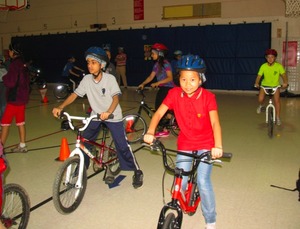 Using Safe Routes to School grant funds, Fairfax County Public Schools (FCPS) has purchased 30 bikes and 6 Strider bikes for bicycle safety lessons at elementary schools. Week-long lessons were conducted at 12 elementary schools last spring for grades 4, 5, and 6, reaching over 8,000 students. Students at several more schools received lessons this fall. Additional grant funds will be used to purchase more bikes to expand the bike program to middle schools. Lessons include bike skills, safety education, signaling, and road simulation riding.
Elementary schools where classes have been held include: Island Creek, Kings Glen, Rolling Valley, Stratford Landing, Washington Mill, Greenbriar West, Lane, Hollin Meadows, Canterbury Woods, North Springfield, West Springfield, Colin Powell, Fort Hunt, Hunters Woods, and Rose Hill. Kudos to Sally Smallwood, FCPS SRTS Coordinator for implementing this program. We hope the program can grow in the near future to allow all elementary students to learn safe bicycling skills. See the Fairfax SRTS Newsletter for more info.
Fairfax County Parkway Trail Restored Between Fox Mill and Pinecrest Roads
Fairfax Water recently replaced a major water main adjacent to Fairfax County Parkway. Major construction work required removing and relocating the Parkway trail. Fortunately, Fairfax Water provided a paved detour throughout the long construction phase, which lasted for several years. In October, construction was completed and the original trail was replaced and opened. We want to thank Fairfax Water for their diligent efforts toward maintaining trail access during the construction period.
Help FABB Identify Bike Rack Locations in Fairfax County
To improve bike parking in the county, help us locate and map existing bike racks. Rackspotter is a web-app that Arlington County is using to map bike racks. The application is now available for mapping racks in the greater DC area. The app allows you to identify the rack type, capacity, and location. You can also add a photo of the rack. As you travel around the county, why not take a minute to map bike racks that you encounter.
-----
November 18, Wednesday - FABB Monthly Meeting in Vienna at 7:30 p.m.
December 16, Wednesday - FABB Monthly Meeting at Mosaic District at 7:30 p.m.
-
Labels: adam lind, candidate survey, fabb newsletter, i-66, I-66 multimodal study, rackspotter, safe routes to school, soapstone connector, soapstone drive, transportation alternatives, wakefield park
posted by Bruce Wright at 1:28 PM permalink
(0) comments
Tuesday, September 15, 2015
Misconceptions about bike infrastructure
 |
Tysons of the future.
Image from Fairfax County |
The Fast Lane, the official blog of the U.S. Dept. of Transportation, recently posted an article entitled
Clarifying Bike-Ped Project Funding, Design and Environmental Review. The article notes that FHWA recently released a new document on Federal funding of bike and ped projects,
Bicycle and Pedestrian Funding, Design, and Environmental Review: Addressing Common Misconceptions.
The publication is an excellent resource for transportation professionals and advocates who want to use Federal funding to make their communities more bicycle- and pedestrian-friendly. Below is an extract from the document. See the link above for the full document including references to resources.
This document is important for those hoping to transform our major roads like Routes 1, 7, and 50 into more bike-friendly roads. These roads are part of the National Highway System (NHS), and in the past traffic engineers have resisted some changes to these roads that would make them more complete streets. The new document addresses misconceptions about what can and cannot be done on NHS roads.
Fairfax County is holding a meeting on September 17 at 7 p.m. at the Fairfax County Department of Transportation, 4050 Legato Road, Suite 400, Fairfax, VA 22033 to
discuss the next round of Transportation Alternatives Program (TAP) projects to be submitted by the county. Please considering attending that meeting to provide input.
Funding Misconceptions
1. The Transportation Alternatives Program (TAP) is the only Federal funding source for pedestrian and bicycle projects.
This is false. While TAP is a popular source of funding for bicycle and pedestrian infrastructure, pedestrian and bicycle projects are eligible for many programs through the Federal Highway Administration (FHWA) and Federal Transit Administration (FTA). At FHWA, pedestrian and bicycle projects are eligible for funding through the Congestion Mitigation and Air Quality Improvement (CMAQ) Program, Surface Transportation Program (STP), Highway Safety Improvement Program (HSIP), National Highway Performance Program (NHPP), Federal Lands and Tribal Transportation Programs (FLTTP), and TAP. The FTA funding may also be available through Capital Funds and Associated Transit Improvement.
2. Federal transportation funds cannot be used to enhance the local roadway network.
This is false. The FHWA guidelines allow National Highway System (NHS) capacity and safety needs to be addressed through a mix of on-system and parallel system network streets. A portion of the local network is part of the Federal-aid highway system. All other roads that have a functional classification higher than local road or rural minor collector are eligible for Federal-aid funding through STP. Projects on local roads and rural minor collectors may be eligible in some cases. Furthermore, STP, TAP, and HSIP funds may be used for bicycle and pedestrian projects along any public road or trail, without any location restriction.
3. Separated bike lanes cannot be built with Federal funds.
4. Federal funds can't be used for road diets.
This is false. Federal funds may be used for road diets, which are generally described as removing vehicle lanes from a roadway and reallocating the extra space for other uses or traveling modes, such as parking, sidewalks, bicycle lanes, transit use, turn lanes, medians, or pedestrian refuge islands. The FHWA supports consideration of road diets or rightsizing when applied at the proper location and has created a
webpage to promote the use of this technique. Road diets can offer significant safety benefits to a community (20-60% reduction in crashes is common) and are one of FHWA's
Proven Safety Countermeasures being promoted through the FHWA
Every Day Counts 3 Initiative. Additionally, in many applications, they are part of city and regionally approved pedestrian and bicycle master plans, and community comprehensive master plans. Localities across the nation are using this low-cost safety countermeasure to improve safety, operations, and livability in their communities.
5. Nonmotorized projects cannot compete effectively for CMAQ funding.
This is false. States have funded more than $1.5 billion in bicycle and pedestrian accommodations with CMAQ Program funds since 1993. The
CMAQ Program is intended to be a flexible funding source to State and local governments for transportation projects and programs to help meet the requirements of the Clean Air Act. Funding is available to reduce congestion and improve air quality for areas that do not meet the National Ambient Air Quality Standards for ozone, carbon monoxide, or particulate matter (nonattainment areas) and for former nonattainment areas that are now in compliance (maintenance areas). Funds may be used for transportation projects likely to contribute to the attainment or maintenance of a national ambient air quality standard, with a high level of effectiveness in reducing air pollution. The CMAQ funding is apportioned to the States to support projects that meet specific eligibility criteria. Some locations give preference to CMAQ eligible quality of life projects, such as nonmotorized transportation projects, as part of their CMAQ funding criteria. See for example the Merced County Association of Governments' Goals and Procedures for Programming CMAQ Funds:
http://www.mcagov.org/DocumentCenter/View/188.
Design Misconceptions
6. The only design standard that can be used on Federal-aid highway projects is the AASHTO A Policy on Geometric Design of Highways and Streets (Green Book).
This is false. The FHWA adopted the American Association of State Highway and Transportation Officials (AASHTO) Green Book as the design standard for projects on the NHS, other than projects on the Interstate highway system, regardless of funding source (23 CFR 625). States may adopt their own standards for non-NHS projects (23 CFR 625.3(a)(2)). The Green Book provides flexibility in design. When a Green Book standard applies but an element of the design is outside the Green Book parameters, a design exception may be considered in accordance with 23 CFR 625.3(f).
Part 9 of the Manual on Uniform Traffic Control Devices for Streets and Highways (MUTCD) is dedicated to traffic control on bicycle facilities. Compliance with the MUTCD on facilities open to public travel is required regardless of funding source, in accordance with 23 CFR 655. In addition to the flexibility the MUTCD provides through Guidance and Option provisions, the MUTCD also contains a mechanism for experimenting with novel traffic control devices (Section 1A.10). Note that some of the traffic control treatments shown in the external resources referenced herein might still be subject to the experimentation process under the MUTCD.
The FHWA's 2013 Bicycle and Pedestrian Design Flexibility Memo supports a flexible approach to the planning and design of pedestrian and bicycle facilities. This memo indicates that FHWA supports the use of additional resources that build off the flexibilities provided in the AASHTO Guide for the Planning, Design, and Operation of Pedestrian Facilities and the Guide for the Development of Bicycle Facilities, as well as the policy based Green Book. These resources include the National Association of City Transportation Officials' Urban Bikeway Design Guide and the Institute of Transportation Engineers' Designing Walkable Urban Thoroughfares. FHWA also recently published the Separated Bike Lane Planning and Design Guide that includes planning considerations and design options for separated bike lanes.
7. Lane widths cannot drop below 11' on the NHS and 9' when Federal funds are used on local roads.
This is false. There is no minimum lane width requirement to be eligible for Federal funding. As stated in the answer to Question 6, States may adopt their own standards for non-NHS roadways. The NHS includes major arterials as well as other roads important to the nation's economy, defense, and mobility. As such, the Green Book generally requires 11' or 12' lanes on these roads. The Green Book allows for lesser lane widths on low-speed facilities and low-volume roads in rural and residential areas; situations in which research shows that narrower lanes should not negatively impact safety if appropriately implemented based on the context. There is no outright prohibition against using lane widths less than those stated in the Green Book, if a design exception is justified and approved in accordance with FHWA regulations and policy. For more information on design standards and design exceptions, please visit
http://www.fhwa.dot.gov/design/standards/qa.cfm.
In appropriate contexts, narrower lanes, combined with other features associated with them, can be marginally safer than wider lanes. The FHWA supports the use of sound engineering judgment in design. The FHWA frames this discussion using the terms
nominal safety versus substantive safety. Nominal safety means a design meets the technical standards; substantive safety means that a design will achieve low crash rates relative to expectations.
8. Curb extensions, trees, and roundabouts cannot be used on the NHS.
This is false. There is no prohibition on incorporating these features on NHS projects.
Curb extensions, also known as bulbouts or neckdowns, can have significant benefits for pedestrian safety. Curb extensions are explicitly supported by FHWA because they enhance the safety of pedestrians, reduce the distance needed to cross the street, and make pedestrians more visible to motorists, particularly when there are parked cars in the vicinity. The related use of medians and crossing islands are FHWA
Proven Safety Countermeasures.
9. Speed limits must be set using the 85th percentile methodology.
This is false. The MUTCD Section 2B.13 contains the following mandatory (Standard) statement: "Speed zones (other than statutory speed limits) shall only be established on the basis of an engineering study that has been performed in accordance with traffic engineering practices." According to the 2012 FHWA Document
Methods and Practices for Setting Speed Limits, there are basic ways of setting speed limits. Use of the 85th percentile methodology is just one part of what FHWA calls the Engineering Approach. This is described as "A two-step process where a base speed limit is set according to the 85th percentile speed, the design speed for the road, or other criterion. This base speed limit is adjusted according to traffic and infrastructure conditions such as pedestrian use, median presence, etc." The 2012 document goes on to say that the engineering approach requires the use of judgment. This is different than simply setting a speed limit based on the measured 85th percentile.
The FHWA developed a model called USLIMITS2, which is a web-based tool using an expert system with a fact-based set of decision rules to determine an appropriate speed limit for all roadway users. For roadway segments that experience high pedestrian and bicyclist activities, USLIMITS2 recommends speed limits close to 50th percentile instead of 85th percentile speed. For more information, visit
http://safety.fhwa.dot.gov/uslimits/.
Environmental Review Misconception
10. Bicycle and pedestrian projects must be within the existing Right of Way (ROW) to be eligible for a Categorical Exclusion.
This is false. As with all roadway projects, FHWA regulations do not require bicycle or pedestrian facilities to be within the existing ROW to be eligible for a Categorical Exclusion. See
23 CFR 771.117(c).
The environmental review process for the National Environmental Policy Act (NEPA) considers environmental impacts of a proposed project, and does not mandate the siting of a project either within or outside of existing rights-of-way. Often an existing highway right-of-way has been disturbed to a point where it may be unlikely that a bicycle or pedestrian project would result in important impacts. This may or may not be true for proposing a project that includes locations outside of existing rights-of-way. If significant impacts result from a project, whether situated entirely within or including some areas outside existing rights-of-way, a categorical exclusion may not be appropriate, and an Environmental Assessment (EA) or Environmental Impact Statement (EIS) would need to be prepared instead.
Labels: cmaq, congestion mitigation air quality, fast lane, fhwa, highway safety improvement program, hsip, national highway system, nhs, stp, surface transportation program, transportation alternatives
posted by Bruce Wright at 2:30 AM permalink
(0) comments
Wednesday, May 6, 2015
Fairfax receives federal funds for bike/walk projects
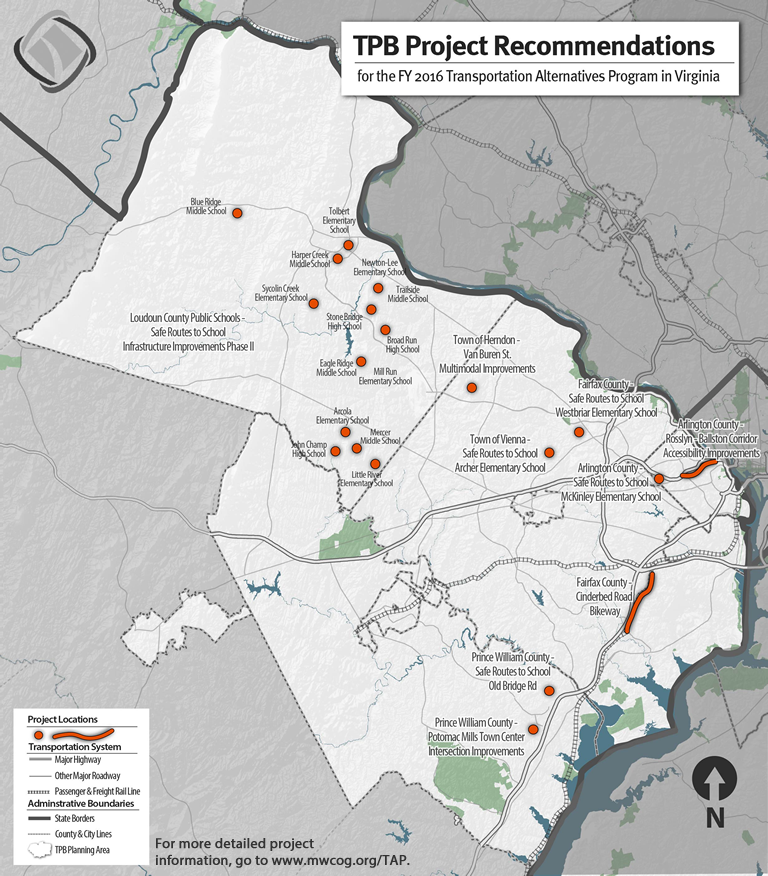
Metropolitan Washington Council of Governments Transportation Planning Board recently approved federal funding for several projects in Fairfax County, mostly related to the Safe Routes to School program:
- $146,000 - Town of Vienna: Louise Archer Elementary School Missing Sidewalks
- $280,000 - Westbriar Elementary School Access - Old Courthouse Road Sidewalk
- $150,000 - Cinderbed Road Bikeway
- $280,000 – Town of Herndon: Van Buren Street Multi-modal Improvements Project
From the TPB:
The Transportation Planning Board recently approved a number of pedestrian and bicycle improvement projects in Northern Virginia to receive funding under the federal Transportation Alternatives Program.
The $2.5 million in funding will cover the capital costs of constructing the projects, which include sidewalk enhancements, new bike lanes and bikeways, and accessibility improvements for persons with disabilities.
The projects are spread across Arlington, Fairfax, Loudoun, and Prince William counties. They were selected by the TPB based on how well they support or advance regional goals, including providing more transportation options, strengthening Activity Centers, improving access to transit, and serving disadvantaged populations.
Labels: mwcog, transportation alternatives, transportation planning board
posted by Bruce Wright at 10:30 AM permalink
(0) comments
Monday, June 9, 2014
Transportation Alternatives Projects in Fairfax County
The Metropolitan Washington Council of Governments (MWCOG) Transportation Planning Board (TPB) recently selected four projects in Fairfax County to receive funding from the Transportation Alternatives Program. Below is info from the
June issue of TPB News
Board Approves Transportation Alternatives Projects for Northern Virginia
On May 21, the TPB approved 13 projects in Northern Virginia for funding under the Transportation Alternatives Program for FY 2015. The Transportation Alternatives program provides funding to projects considered "alternatives" to traditional highway construction and that expand travel choices, and enhance the transportation experience by integrating modes and improving the cultural, historical, and environmental aspects of the Washington region’s transportation infrastructure.
Fairfax County
Cinderbed Road Bikeway - Construct a 3.1 mile connection between Fort Belvoir and the Franconia-Springfield Metrorail station.
Funding - $400,000
Cross County Trail in Lorton - Construct a segment of the Cross County Trail that will connect the Occoquan Regional Park and Laurel Hill Greenway via the Lorton Arts Foundation.
Funding - $353,057
Safe Routes to Schools: Westbriar Elementary - Complete missing segments of sidewalk along Old Courthouse Road.
Funding - $200,000
Town of Herndon
Herndon Historic Revitalization Project - Improve streetscape design and pedestrian accessibility, safety, and mobility in downtown Herndon.
Funding - $6,584
Labels: mwcog, transportation alternatives, transportation planning board
posted by Bruce Wright at 12:58 PM permalink
(2) comments
Wednesday, August 21, 2013
Fairfax bike projects receive funding
Several bike projects received funding from the Transportation Alternatives program, the replacement for Transportation Enhancements funding from US Dept. of Transportation. The
WashCycle has a good summary of all regional projects that received funding. Here's a list of Fairfax projects:
Transportation Alternatives is the consolidated program in the latest federal transportation law, MAP-21, that funds expanded travel choices like bicycling and walking, or that make other enhancements like mitigating the environmental impacts of transportation facilities. The Transportation Planning Board (TPB) is the entity tasked with allotting this money in the DC Region.
- Fairfax County will receive funding to install bike stations and operating hardware to support the expansion of Capital Bikeshare to Reston, which the County hopes will give people more options for accessing Metrorail stations along the planned Silver Line.
- Fairfax Mason to Metro Bicycle Route. Develop a backbone bicycle route through the City and into Fairfax County to connect George Mason University with the Vienna Metrorail Station. The project aims to increase and improve bicycle and pedestrian travel between major hubs of activity in the City of Fairfax, Fairfax County, and George Mason University.
- Pickett Road Trail Underpass. Install a 12 foot wide concrete trail under the existing Pickett Road bridge over Accotink Creek, and construct asphalt trail segments to connect the underpass to the existing City of Fairfax trail system. Install two culverts to convey existing storm drainage outfalls under the proposed trail, and install wayfinding signage.
- Cross County Trail - Lorton. The proposed section of the Cross County Trail in Lorton will traverse the Lorton Arts Foundation property and connect Occoquan Regional Park and the Laurel Hill Greenway
This is great news for Fairfax cyclists. The bike share system in Reston will be the first in Fairfax County. The funding will help implement the system but the county will need to find funding for operating costs and additional staff to help manage the system. With the coming of Metro to Reston next year, and a mostly connected trail system, bike sharing will be a great way to get around Reston. See
previous articles on
bikesharing in
Reston. Thanks for Supervisor Hudgins, bike coordinator Charlie Strunk, and members of the Reston community for supporting this effort.
The Mason to Metro Bicycle Route and the Pickett Road Trail Underpass projects are linked. The underpass will provide a safer connection across Pickett Road for cyclists traveling between the Vienna Metro station and Mason. FABB members have been part of this planning effort for several years and their hard work is paying off.
Labels: bike share, george mason university, pickett road, reston, transportation alternatives
posted by Bruce Wright at 9:00 AM permalink
(0) comments
Monday, June 17, 2013
Public hearing on bikesharing application
The Board of Supervisors is holding a public hearing on Tuesday, June 18 on two "Transportation Alternatives Program (TAP) applications to be submitted to the Metropolitan Washington Council of Governments (MWCOG) for FY 2014 funding." The following is a description of the two projects, from the
Board Package (p. 263):
For the FY 2014 Transportation Alternatives Program, staff recommends that the Board endorse the following two projects:

- Cross-County Trail, Lorton $400,000 (TAP) $100,000 (80%)
- Reston Bike Share, Support Infrastructure $400,000 (TAP) $100,000 (80%)
LIST OF PROJECTS WITH MATCHING FUNDS IDENTIFIED (Descriptions Based on Information Provided by Applicant)
1. Cross County Trail, Lorton (CCT)
Fairfax County Department of Transportation is proposing the design and construction of a new multi-use trail to provide non-motorized access between the Occoquan Regional Park and the Laurel Hill Greenway, both of which are portions of the Cross County Trail. The trail connects users with the historic Workhouse Arts Center, a program of the Lorton Arts Foundation (LAF), which is listed on the National Register of Historic Places, and enhances an already significant historic destination.
The CCT, Lorton will connect with the regional network of existing and planned trails, including: High Point Trail, Fairfax Cross-County Trail, the Laurel Hill Greenway, and the Potomac Heritage National Scenic Trail. Specifically, the Potomac Heritage National Scenic Trail system consists of a braided network of trails identified as a trunk line in the greenways task force study, and a key historic and scenic element running from the mouth of the Potomac to Pittsburgh Pennsylvania. The Potomac Heritage National Scenic Trail (PHNST) is one of the 24 Congressionally-designated trails in the National Trails System and one of seven scenic trails in the U.S. The PHNST sites identified for this project will offer communities significant enhancements to existing recreational amenities, leverage heritage tourism and economic benefits, expand non-motorized transportation networks, create educational and interpretive experiences, connect neighborhoods, historic sites and parkland, and rebuild community connections.
The improvements to this section of trail will provide residents of higher density neighborhoods and the newer developments that surround the Workhouse Arts Center buildings with safe multi-use trail access to many recreational facilities and places of historic interest in the area including: Occoquan Regional Park, The Town of Occoquan, and to the other sections of the Cross County Trail. The LAF portion of the trail is three miles west of South County Secondary School and will offer expanded recreational opportunities for their athletic programs. Residents and visitors will have a safe pedestrian and bicycle route to businesses, bus stops, and other commuter transportation facilities in Lorton.
To make the Lorton portion of the CCT truly a multi-use trail, it will be 18 feet wide. There will be a natural surface for horses, four feet wide; a paved bike/pedestrian portion, ten feet wide; plus an additional four feet on the sides.
2. Reston Bike Share – Support Infrastructure
Fairfax County Department of Transportation (FCDOT) is exploring the feasibility of bringing the Capital Bikeshare program into Reston. This is in anticipation of the Metrorail opening in Reston as an expanded transportation option for users of the Metrorail who will commute to Reston. A bike share is a program of “public use” bicycles that users who have registered with the program can rent for short periods of time. The bikes can be used to go from bike dock to bike dock located at activity centers and employment centers throughout the Reston area. Capital Bikeshare, in operation in Arlington County, the City of Alexandria, and the District of Columbia, offers system users with several membership options ranging from an annual membership to daily passes. Subscribers are given an electronic key that is used for renting a bicycle. The first 30 minutes of usage are free with each additional 30 minutes escalating in cost.
The Reston Bike Share expansion would be the first in Fairfax County. Bike share programs work best in dense urban areas with good bicycle infrastructure. At this time, Reston is the best candidate in Fairfax County for a bike share program.
The final locations of the stations will be determined in the preliminary engineering/study portion of the project. After the final locations are determined FCDOT will construct the needed infrastructure to make the final connections to the stations.
Labels: bike share, transportation alternatives
posted by Bruce Wright at 2:03 PM permalink
(0) comments
Thursday, May 16, 2013
Fairfax County applies for funding for bikeshare feasibility study
Fairfax County recently applied for funding of a bikesharing feasibility study through the Metropolitan Washington Council of Governments
Transportation/Land Use Connections (TLC) Technical Assistance Program. "The TLC Technical Assistance Program provides focused consultant assistance to local jurisdictions working on creative, forward-thinking and sustainable plans and projects."
While several areas in the county could support bike sharing, the study will focus on the Reston area. Reston has a network of recreational trails, concentrated mixed-use development at the Reston Town Center, Village Centers located within easy biking distance of most residents, and the soon-to-be-completed Wiehle Ave Metro station. Much more needs to be done to make Reston truly bike-friendly but we think bike sharing could work there.
Last year we wrote an article about the feasibility of bikesharing in Reston. The article was
cross posted on Reston Patch.
Below is a letter from Chairman Bulova to MWCOG regarding the application:
In March of 2013, the Metropolitan Washington Council of Governments (MWCOG) released its request for FY2014 Transportation/Land Use Connections (TLC) Technical Assistance Program applications. This program is designed to provide technical assistance to local jurisdictions working on creative, forward-thinking and sustainable transportation and land use plans and projects. In response to MWCOG’s request, please find attached for your consideration an application for conducting a feasibility study titled, “A Study to Explorethe Feasibility of Implementing Capital Bikeshare in Reston, Virginia”.
With the popularity of Capital Bikeshare (CaBi) growing in Arlington, the District, and now Alexandria, we are receiving more and more requests to bring CaBi to Fairfax County. While we acknowledge that many areas of the County can’t support bike sharing, we strongly believe that it can work in in our emerging urbanized centers and transit station areas such as Tysons Corner, Merrifield-Dunn Loring, and Reston. However, further study is required to determine the feasibility of Capital Bikeshare: can it work in an urbanized center such as those mentioned, what are the associated costs (both capital and operating), Where should the stations be located, and how many stations and bikes are needed to make this system successful?
Technical assistance through the “Transportation/Land Use Connections Program” can provide the necessary guidance and support to define the feasibility of Capital Bikeshare and address these issues. After consultation with our Department of Transportation bicycle program staff as well as bicycle advocates, the Reston area of the County was chosen. Our reasoning is based on the following: the Reston area has the highest concentration of active bicyclists in the County, there is an emerging bike culture forming, Reston embraced our first two road-diet projects which included bike lanes, and there is strong corporate and residential support to initiate bike sharing in Reston. Furthermore, the findings developed from conducting this study can assist other areas of the region in making sound decisions regarding bike sharing.
I believe this application is in the spirit of the TLC program and will aid in the County’s planning efforts to accomplish the goal of balancing multi-modal transportation and landuse.
In July 2011 Charlie Denney of Capital Bikeshare was interviewed by Delegate Ken Plum on the benefits of bikesharing:
Labels: capital bikeshare, mwcog, reston, transportation alternatives
posted by Bruce Wright at 1:05 PM permalink
(0) comments
Thursday, January 31, 2013
Fairfax Board of Supervisors endorses FY2014 trail projects
Today the Fairfax County Board of Supervisors endorsed three major trail project funding applications that will be submitted to VDOT for Transportation Alternatives funding. The
Transportation Alternatives Program is the successor to the federal Transportation Enhancements program. This year VDOT is only accepting applications for grants that have current Transportation Enhancement funding. Next year VDOT plans to open the program to new applications. The three projects are:
Cross-County Trail (CCT) in Lorton— Fairfax County is proposing the design and construction of a new multi-use trail to provide non-motorized access between the Occoquan Regional Park and the Laurel Hill Greenway, both of which are portions of the CCT. The trail connects users with the historic Workhouse Arts Center, a program of the Lorton Arts Foundation (LAF), which is listed on the National Register of Historic Places, and enhances an already significant historic destination.
Mason Neck Trail—Construction of a multi-use trail to provide non-motorized access to the historic, environmental and recreational resources of Pohick Bay Regional Park, the Meadowood Recreation Area, Gunston Hall Plantation, Mason Neck State Park and the Elisabeth Hartwell Mason Neck National Wildlife Refuge.
Phase III of the Georgetown Pike Walkway Project—The project will be constructed at the western end of Georgetown Pike, connecting the Seneca Shopping Center and site of the historic Salem Baptist Church with the western terminus of Georgetown Pike Trail Project – Phase 2.
See information provided to the Board at today's meeting,
Endorsement of the FY 2014 Virginia Department of Transportation’s Transportation Alternatives Grant Applications staring on page 189.
What projects should Fairfax County consider for next years program?
Labels: cross county trail, georgetown pike trail, mason neck trail, transportation alternatives, transportation enhancements
posted by Bruce Wright at 6:09 PM permalink
(1) comments
Thursday, June 23, 2011
New Yorkers for bicycling
 |
| Pledge badge |
A New York bicycle advocacy group,
Transportation Alternatives, has started a campaign for mutual respect by all road users. They realize that many road users, including bicyclists, flagrantly abuse the rules of the road. As a bicycle advocacy group they are asking their supporters to take a pledge to
Declare yourself a New Yorker for Bicycling.
If you sign the pledge, you can receive one of several Bicycle Ambassador Badges "T.A. wants you to show off the way you ride. When a bicyclist is well-behaved, passing cyclists feel pressure to do the same. If we all wear our behavior on our sleeve (or back or bag), the message becomes a movement.":
I pledge my support for the three pillars of safe cycling in New York:
- Responsible riding is safer for everyone.
- Bike lanes keep everyone out of each other's way and out of harm's way.
- A robust public bike share program empowers New Yorkers with more transit choices.
I support these principles because more New Yorkers riding bicycles on NYC streets benefits New York as a whole. Bike-friendly enhancements to our streets improve New Yorkers' health, increase pedestrian safety and bolster a more vibrant business community.
As a bicyclist, I vow to ride safely and create a positive street environment. As a pedestrian, transit rider or driver, I support the right to safe travel for New Yorkers who choose bicycling and recognize that we're all better off when everyone has safe space to travel. In the interest of a greener, greater New York, I call on my elected and appointed officials to do the same.
Signed,
Labels: transportation alternatives
posted by Bruce Wright at 2:05 PM permalink
(0) comments