
Sunday, October 13, 2013
Transformation of New York streets
Jonathan Krall of the Alexandria Bicycle and Pedestrian Advisory Committee sent out this note about an excellent TED talk by Janette Sadik-Kahn, New York City transportation commissioner, on how New York is reclaiming many of it's streets and turning them into spaces for people in the form of parks, bike lanes, and other innovative uses:
A friend (thanks!) drew my attention to this very recent TED talk by Janette Sadik-Khan, Transportation chief for NY City. She does a great job of showing how streets are a public resource that can be re-imagined and re-used at little expense without increases in automotive congestion and with improvements in measured safety. Some of these ideas, such as a pedestrian plaza where sidewalks are most crowded, are being proposed for my own city of Alexandria, but it is hard to imagine our transportation guy delivering such a transformational message.
She also points out that, at a time when a newly installed bike lane was reported to be the most hotly contested real estate outside of the Gaza Strip (that's how the media characterized it), 64 percent of the public was in still in favor. The talk is 15 minutes in length.
I'm sure you can imagine using some of these techniques on some of our big roads in Fairfax.
Labels: janette sadik-khan, new york city, ted talk
Saturday, May 11, 2013
Bikeways are good for business
New York DOT recently completed a study that shows that where protected bikeways are installed, local businesses thrive:
In many ways, these data come as no surprise. We know that when towns invest in bicycle infrastructure, people will ride more — the number of people traveling by bicycle increases when there is infrastructure to make traveling by bike safe and easy.
We also know that people who travel along a street by bicycle have fewer barriers to stopping at a local business than people who travel along the same street by car. It's very easy to hop off a bicycle and find a place to secure the bike; not so with finding parking for an automobile. In fact, a recent study suggest that bicycle riders tend to spend more at local businesses over the course of a month.
It will be really interesting to see what effect bike sharing will have on New York.
City officials say the nation's largest bike-sharing system will begin sometime this month with 6,000 bikes at 330 stations in Manhattan and parts of Brooklyn, with plans to expand eventually to 10,000 bikes and 600 docking stations in Manhattan, Brooklyn and Queens.
"When you talk about scale, no other U.S. city comes close," says Jon Orcutt, policy director at the city's Department of Transportation, which is overseeing the launch of the program.
Officials hope the privately funded bike-sharing program, dubbed Citi Bike after a $41 million sponsorship from Citibank and an additional $6.5 million from MasterCard, will add riders to the more than 700 miles of bike lanes throughout New York and will be used by one-way commuters and round-trip tourists alike.
Labels: bike share, cycle track, new york city
Thursday, November 1, 2012
Only bicycles seemed to be rolling.
That's a quote from the New York Times article on the transportation gridlock that occurred as a result of Hurricane Sandy, Long Gas Lines, Clogged Roads and Slim Hope for a Better Day. Bikes and walking were about the only means of transportation that were feasible with the clogged streets and inactive subway system:
The storm damage had a synergy of its own. Efforts to pump floodwaters from subway and automobile tunnels were slowed by electrical shortages. Hastily arranged car pools became bogged down on highways and city streets clogged with other commuters. Many gas stations, without power to operate their pumps, could not open for business, eerily evoking the fuel crisis of the 1970s.
Only bicycles seemed to be rolling...
City buses, the only piece of the mass transit network operating in earnest on Wednesday, often bypassed waiting commuters, unable to take on more passengers. Those who did make it on board often got off well before their stop, reasoning that they could walk faster...
With no underground route from Queens to Manhattan and car traffic stalled, some crossed the Ed Koch Queensboro Bridge on bike or foot. One Twitter user described cycling over the bridge as “escaping zombie apocalypse.”
Labels: hurricane sandy, new york city
Monday, January 31, 2011
Youth Bike Summit

More than 200 participants from 14 states and two countries came to New York this past weekend to swap ideas, learn bicycle advocacy best practices and build nationwide momentum in the country’s first-ever Youth Bike Summit, sponsored by Recycle-A-Bicycle. The youth spent three days learning everything from map-making techniques to political organizing strategies, participating in roller races and developing an action plan to advance biking in NYC and places beyond.
To kick things off, DOT Commissioner Janette Sadik-Khan acknowledged the event’s female leaders by evoking Susan B. Anthony’s 1896 quote, "I think the bicycle has done more to emancipate women than anything else in the world." She then introduced Kimberly White, an 18 year old intern at Recycle-A-Bicycle as the Summit’s keynote speaker.
Labels: janette sadik-khan, new york city, youth bike summit
Friday, December 31, 2010
New York's bike lanes discussed on Market Place
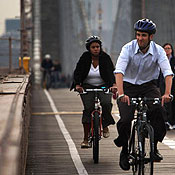
Janette Sadik-Khan: We've put down 250 miles of on-street bike lanes in the last three years. We've put down thousands of new bike racks to make it friendlier for people to get around by bike.
And the city just announced it's preparing to install a bike share program with 10,000 bicycles.
In some communities, the commissioner is revered. Carol Coletta, president of CEOs for Cities, calls her a goddess.
Carol Coletta: She has made these transformations in New York with speed that would be breathtaking for a small start-up, to say nothing of a bureaucracy like a city of this size.
But for some, the changes feel like a punch in the gut. One of those people is Marty Markowitz, the borough president of Brooklyn. Markowitz thinks a two-way bike lane along Prospect Park goes too far, because it takes space away from cars and gives it to bikes. Here's how he describes the commissioner.
Marty Markowitz: She is a zealot. She wants to make it hard for those that choose to own their automobiles. She wants to make it difficult, their life difficult. I really believe that.
For Markowitz, it's about defending mom-and-pop shops, and middle-class workers who use their cars to get to work.
But supporters have shouted back. And, it turns out, one survey shows three-quarters of Brooklynites support that bike lane.
For some New York businessmen, being able to attract international companies is key. Janno Lieber is president of World Trade Center Properties. He's overseeing the construction of 10 million square feet of office space to replace the Twin Towers. He says being able to bike to work is important to his tenants.
Janno Lieber: It also makes us more familiar and attractive to some of the European and international companies because otherwise people are going to go to lower cost locations.
Lieber says in New York, bike lanes have cache with the creative class.
Lieber: Well, because, the kind of employees who bike, those are the kinds of workers that companies really want to have, and they want to hold on to.
And Lieber says, that's who will build New York's economy.
Labels: bike lanes, new york city
Tuesday, October 19, 2010
New York City bike commute video
New York City's streets are undergoing a major transformation. Bike facilities are being implemented throughout the city, and the number of cyclists is increasing dramatically. This video of a StreetFilm employee's 11-mile commute to work shows some of the bike facilities that are being developed.Labels: new york city, streetfilms
Saturday, October 2, 2010
New York streets transformed to serve people
Check out this new video on some of the things NYC is doing to transform it's streets:From GreaterGreaterWashington.
Labels: new york city
Monday, September 20, 2010
Women in Motion: New Lady Riders Relfect on NYC Cycling
Many people have posted links to this video by Streetfilms. I'd love to see a condensed version of this as a TV commercial, just so people can hear why it makes so much sense to travel by bike. Several new women bike riders explain why they started riding: "I started getting interested in biking when I noticed all the bike lanes and all the bikers and I said 'Hey, I don't necessarily need my gym subscription, I can ride my bike everywhere.'" "It's a lot more than a sport." Check it out:Women In Motion: New Lady Riders Reflect on NYC Cycling from Streetfilms on Vimeo.
Labels: new york city, streetfilms
Saturday, November 14, 2009
Biking in New York, 1980-2009
 Good transportation blog recently posted the article Biking Is Way Up in New York City. Again. that includes a good chart showing growth of cycling since 1980-2009. With better facilities, cycling has grown from about 2000 in 1980 to around 15,500 now. "According to the most recent data from the New York City Department of Transportation, biking in the city skyrocketed again this year. The colored bars represent the number of bikes counted at different commuter points over the course of a single day."
Labels: bike commuting, new york city
Tuesday, November 3, 2009
Congressman Blumenauer rides in New York City
Today Streetfilms released a short film about a visit to New York City by Congressman Earl Blumenauer:Rep. Earl Blumenauer dropped by Transportation Alternatives' offices to take a quick excursion around mid-town with Executive Director, Paul Steely White, and Senior Policy Director, Noah Budnick. They checked out a few standard (painted) bike lanes and some of the newer (physically separated) facilities, of which the latter Mr. Blumenauer thought were superior. Along the way he offered much commentary about the state of biking and livable streets in the nation.
Labels: congressman blumenauer, new york city


