
Bike Share Transit Act Introduced
Good news for communities like Fairfax County how are beginning to implement bikesharing. From the League of American Bicyclists, posted on Jan. 7: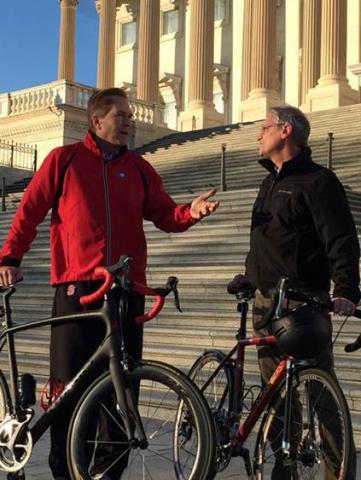
Some bikeshare systems have already utilized federal funding sources, like Fort Worth BCycle which has used Federal Transit Administration (FTA) and Federal Highway Administration (FHWA) funds. The Bikeshare Transit Act makes this federal funding easier by:
- Allowing bicycles to be funded by FTA funds, and
- Making it clear that bikeshare projects and associated equipment are eligible for federal transit funds and FHWA Congestion Mitigation and Air Quality Improvement funds.
Labels: bikeshare, congressman blumenauer, congressman buchanan
Congressman Blumenaber's response to Post op-ed

Here is Congressman Blumenauer's response:
Younger Americans don’t just drive less — many choose not to have driver’s licenses. They would rather spend their time and money on technology and experiences. They use cars without being tethered to them. Increasingly, many prefer biking, taxis and ride-hailing services and mass transit. Their baby-boomer parents and grandparents are finding the car-dominated lifestyle in which they grew up to be increasingly unsatisfying. They, too, are moving to urban neighborhoods and reducing their automobile use.
Clearly, not everyone has abandoned motor vehicles. Some prefer to drive everywhere and don’t mind the time and expense. Because so many communities surrendered to the car long ago, too many Americans have no real choice. Those who do have choices, young and old, are opting for the balanced transportation systems of livable communities that look nothing like Mr. Atkinson’s view from the 1970s.
Earl Blumenauer, Washington
Labels: congressman blumenauer, social engineering
Notes from 2014 National Bike Summit
 |
| US Transportation Secretary Anthony Foxx |
Opening Plenary
Congressman Blumenauer reminded the group of his oft-repeated quote: "How many Americans are stuck in traffic on their way to ride an exercise bike at the health club?" We would all be healthier if we had safe, connected bike routes. He noted that Houston recently allocated $200 million to build 150 miles of trails within the city.
His major point is that the 18.4 cents/gallon gas tax has not been raised since 1993. He wants to increase the gas tax by 15 cents/gallon over three years. Our infrastructure is falling apart and the highway trust fund will run out of money this fall. Federal funds for bike projects, formerly Transportation Enhancements, have been cut. The increase could lead to more funds for rebuilding our infrastructure, providing better transit options, and increasing funds for bike projects.
Representative Albio Sires of New Jersey spoke about his bipartisan bill, HR 3978. "The New Opportunities for Bicycle and Pedestrian Infrastructure Financing Act of 2014 (NOBPIFA) will allow communities to take advantage of low-cost financing for projects that make streets and sidewalks safer for all users through a new federal credit assistance program that would direct millions specifically for low-income communities."
Douglas Meyer surveyed local elected officials on their attitudes toward bicycling issues. The survey was conducted between Jan-Feb 2014. There was almost universal support for improving bike conditions and providing multimodal transportation options. The following reasons were cited: health, quality of life, to attract new, younger employees, and to compete with other bike-friendly cities. They resent anti-car arguments but support multimodal transportation choices. What's needed to succeed is a political leader, examples of projects that work, making connections, and allocated funding. We need better data to show the cost effectiveness and safety aspects of good bike projects. They are all aware of the bike sharing concept and many think it is a great way to increase bike use.
Bill Reduto, Mayor of Pittsburgh - During a meeting with President Obama he asked for the scaffolding on the Washington Monument so that cyclists can ride the Great Allegheny Passage from the Monument in DC to the monument scaffolding in Pittsburgh. His goal is for Pittsburgh to be in the top 10 Bicycle Friendly Communities in the U.S. Even in Pittsburgh where streets are narrow and road space is tight, room is being dedicated to bikes. All new projects need to provide a complete streets vision.
Overcoming the Scofflaw Perception
Laura Solis of Bike New York discussed a campaign in New York City called Don't be a Jerk, a series of humorous videos on riding with traffic, staying off the sidewalk, and yielding to pedestrians. She noted that Bike Smart: The Official Guide to Cycling in New York, is available in eight languages and is given to most new bike owners when they purchase a new bike.
The following three speakers discussed bike education and traffic ticket diversion programs in which motorists and cyclists can avoid bicycle infraction-related traffic penalties by attending a bicycle safety class. Rich Conroy, also of Bike New York, said that Bike NY holds an hour and a half class each month for approximately 10 cyclists who have committed infractions, usually riding on the sidewalk, which is a misdemeanor, or wrong-way riding. He informs those cyclists of their rights and how they can contest a ticket that may have been issued in error. When the program began many cyclists incorrectly received tickets for not riding in the bike lane. Rich has attended Police Roll Call meetings to discuss cyclist's rights and to hand out a one-page flier. Bike New York also conducted 35 bike safety classes for over 700 new Citi Bike members.
Tyler Dewey of Bike Athens in Georgia discussed their diversion program. Their one-hour class is given once a month in English and Spanish. It costs $30 and if completed cyclists can avoid a $125 fine. Fines for bicycle tickets are waived upon completion of the course.
Brian Botwin of Commute Options in Bend, Oregon conducts a monthly bicycle safety class as part of the city's bicycle diversion program for cyclists ticketed for running red lights and wrong-way riding.
Retailers Best Practices for Advocacy
Brian Drayton of Richmond (CA) Spokes, a community bike shop involved in youth training. Many riders who use the shop depend on their bikes for transportation. While most bike shops do not want to work on big-box store bikes, they are often the only bikes low income riders can afford. By helping these riders shops can gain important allies.
Jeff Koenig of Big Poppi Bicycle Company in Manhattan, KS discussed the importance of locally owned bike shops to their communities. He noted the loss of brick and mortar bike shops over the years, in part due to the commoditization of bike products. Bike shops and the advocacy community depend on each other and need to work together. Advocates need to understand that shops have very small profit margins and their cooperation means more than, and may not include, providing discounts or monetary contributions.
Chris Kegel of Wheel & Sprocket in Milwaukee said retailers and advocates need to get involved in the political process. A good way to influence the process is to form a Political Action Committee (PAC) to help elect pro-bike candidates (see Cascade Bike PAC as an example).
Lunch speakers
US Transportation Secretary Anthony Foxx began his talk by showing a photo of himself riding a Charlotte bcycle bike. He noted that the 6th round of TIGER funding would soon be open to applications for bike projects. He said biking is about more than recreation, that we need all forms of transportation. Even though national crash fatalities are at record lows, bicyclist and pedestrian deaths have only had a small decrease. He mentioned the success of road diet projects in Charlotte.
Gabe Klein of the Urban Land Institute, formerly headed Chicago and DC departments of transportation. He stressed the importance of throughput vs. speed; we don't need to go fast to have efficient traffic flow. He has been able to create extensive bike infrastructure in DC and Chicago through hard work and persistence, funding from multiple sources, and support from the top. He prefers two-year plans with measurable results. Chicago's Vision Zero plan has a goal of zero ped, bike and overall traffic fatalities in 10 years through the use of 300 speed cameras, 20 mph residential streets, and other measures. Vision Zero is described in Chicago Forward and includes a goal that 5% of all trips of 5 miles or less be made by bike. Bike advocacy organizations are key partners in helping make change in those cities. Gabe thinks that when autonomous vehicles are in place they will be in near-constant motion and there will be much less need for parking spaces. These spaces can then be used for ped/bike facilities.
Matt Klein of Urban Land Institute. Discussed three factors and how they affect cyclists: Economics: Parking is dilutive to overall project returns, with structured parking spaces costing $45-85K/space. The real estate community supports reduced parking minimums and understands the importance of ped/bike access. Sustainability is an important issue with developers, who want to build LEED-certified buildings that include bike parking and access, especially since new employees (Millenials) are demanding these facilities. Mainstreaming: Established business organizations are not as supportive of bike access and facilities. Cyclists should reach out to them.
John Cayer of Kimberley-Clark, the main sponsor of the National Bike Challenge. The goal this year is 50,000 riders pedaling 30 million miles between May and October.
Making a Compelling Video
 |
| Max Hepp-Buchanan speaking, Gary Fisher in the foreground |
Yolanda Davis-Overstreet of Ride in Living Color showed a clip from the film about African Americans and other people of color on bikes that she has been developing for several years. Her goal is to promote healthy lifestyles in the African American community where one of very two kids born today will develop diabetes (vs. 1/3 of all kids).
Max Hepp-Buchanan of Bike Walk RVA in Richmond, Virginia showed his film of a visit of elected officials and local government staff to Arlington and DC to tour bike facilities. Most of the film was produced using in-kind donations from the filmmaker. FABB showed the video during the 2013 Fairfax Bike Summit.
General advice from the video group included: short (3-4 minute) videos are often the best; iPhone Voice Memo works well for audio recording (Gary Fisher noted that a small iPhone compatible microphone from B&H improves sound quality); always have contracts in writing; don't let cartoonists get too creative; use short sentences; spoken text is different than written text. Most used Final Cut Pro (the earlier version) for doing their editing, although iMovie is OK to start.
Many of the participants were on Capital Hill today meeting with their Congressional reps to ask them to support bike-related issues and to join the Congressional Bike Caucus.
Thanks to our FABB supporters whose contributions allowed me to attend the Summit.
Labels: anthony foxx, congressman blumenauer, diversion program, gabe klein, national bike summit, scofflaw cyclists, video
Press conference on funding for bike facilities

Senator Cardin (MD) and Representative Blumenauer (OR) will be at the press conference, as will Andy Clarke of the League of American Bicyclists and others, to mark the release and discuss the importance of biking and walking for transportation.
The press conference will be on Wednesday, May 9 from 9:15 - 10:30 AM. At the House Triangle, located directly in front of the Capitol Building on the House side. The press event follows a National Bike to School Day celebration in Lincoln Park. From 7:30 - 8:30 a.m., school children will gather in Lincoln Park and ride in “bike trains” to nearby Capitol Hill public schools.
If you are not involved in Bike to School Day consider attending the press conference to ensure there is a good showing of folks with bikes. Biking and walking funds are on the line-funds that benefit bike projects in Maryland, DC, and Virginia. Read the America Bikes press release about the event.
Labels: america bikes, bike to school day, congressman blumenauer, league of american bicyclists, senator cardin
Modifications to bicycle commuter tax benefit law introduced
The Bicycle Commuter Tax Benefit has been in place since January 2009. Bicycle commuters who bike 3 or more times a week for a month can receive $20 toward bike commuting expenses. Unfortunately not many companies have implemented the benefit. It cannot be used in conjunction with the transit benefit. It's not easy to implement.Congressman Earl Blumenauer of Oregon introduced the bill that became the Bicycle Commuter Tax Benefit. He understands the limitations of the law and wants to make changes. He is sponsoring the Commuter Relief Act:
- Increase the amount of the bike commuter benefit from $20 to $40 a month.
- Allow bike commuters to combine the bike commuter benefit with other fringe benefits — up to $200. For example, You could use the $40 bike benefit and collect up to $160 of your public transit benefit.
- Cap all transportation fringe benefits at $200 a month (the parking benefit is currently $230, the transit cap will drop to $130 at the end of 2011).
- Allow self-employed people to receive transit fringe benefits for work-related commuting.
- Require employers offering a parking transportation fringe benefit to also offer employees the option to take cash instead. This would create an incentive for more people to leave the car at home and take cheaper options, like transit, biking, and walking.
- Create a 10 percent tax credit for vanpool expenditures
Labels: bicycle commuter tax benefit, congressman blumenauer, congressman moran
Congressional letter supporting US DOT bicycle policy
As we reported earlier, at this year's National Bike Summit Transportation Secretary Ray LaHood announced new Federal policy recommendations to state DOT's to ensure that bicyclists and pedestrians are treated as equals with other transportation modes. As Secretary LaHood said at the time, "This is the end of favoring motorized transportation at the expense of non-motorized."The policy has received some pushback from a few highway special interest groups, including the trucking industry and the National Association of Manufacturers. LAB posted a good response to their mis-characterization of the policy.
Yesterday Congressman Blumenauer and twenty-three of his colleagues, including Congressmen Connolly and Moran, sent a letter to Secretary LaHood supporting the new Policy Statement on Pedestrian and Bicycle Accommodations, Recommendations, and Regulations. According to the letter:
Labels: congressman blumenauer, transportation secretary LaHood
Active Community Transportation Act
 Congressman Earl Blumenauer (D-Oregon, OR) will introduce the Active Community Transportation Act of 2010 (the ACT Act) on Monday. According to this Rails to Trails fact sheet, the bill will:
The U.S. Department of Transportation will administer a competitive fund, which will invest in communities that best make the case for resources to shift large numbers of trips from driving to walking and bicycling.
Labels: ACT act, active transportation, congressman blumenauer
David Byrne at the Newseum
 It was a full house last night at the panel discussion sponsored by the Brookings Institute that included musician and cyclist David Byrne, Congressman Earl Blumenauer, and Janette Sadik-Khan, Commissioner, New York City Dept. of Transportation.
David Byrne is the author of the new book "Bicycle Diaries [which] chronicles David’s observations and insights — what he is seeing, whom he is meeting, what he is thinking about — as he pedals through and engages with some of the world's major cities." His talk was more about liveable places and less about bicycling. In his first slide of Columbia, MD he noted that his parents moved there several years ago and now that they don't drive, find it very difficult to get around. "They're stuck." As are many people who have depended on driving for much of their lives and now need other ways to get around.
He mentioned some of his favorite books about places including Twenty Minutes in Manhattan by Michael Sorkin, The Death and Life of Great American Cities, by Jane Jacobs, and The Timeless Way of Building by Christopher Alexander.
After discussing cycling in various cities of the world he noted the transformation of Portland, Oregon into a bicycle-friendly city. Merchants who at first resisted removing on-street parking for bike corrals, are now requesting them. Replacing two on-street parking spaces makes way for 25 bike parking spots. And instead of having a van blocking the view of the store, motorists can clearly see through the bikes.
Congressman Blumenauer continues his efforts for cyclists, whom he sees as indicator species for liveable communities (Sadik-Kahn says that families on bikes are indicator species for bicycle-friendly communities). He has a vision of kids, who aren't obese and who once again get to school under their own power. He hopes to expand the Safe Routes to School Program to include high schools.
The bike industry in Portland, which Blumenauer has represented in Congress for 10 years, is worth $100 million in economic activity each year. Families there spend $2500 lees for transportation each year. To foster active transportation choices in the U.S. he plans to sponsor the Active Transportation Fund of 2009 bill in Congress. (See the proposed legislation (pdf)). Portland "has been able to increase its bicycle mode share by 400% in the last two decades for the cost of one mile of freeway."
The final speaker was Janette Sadik-Khan who has lead the transformation of New York City streets. Noting that bicycle standards documents haven't kept up with some of the more innovative bicycle facilities being implemented in Portland, New York City and elsewhere, she announced the formation of Cities for Cycling "a project of the National Association of City Transportation Officials to catalog, promote and implement the world's best bicycle transportation practices in American municipalities."
Both Blumenauer and DDOT director Gabe Klein mentioned that the powers that be need to hear from cyclists. Blumenauer issued a call to action by saying "we've been too accepting of the status quo. We need to agitate more." We need to challenge people who say we shouldn't be spending money on more bike and ped facilities because most people drive. About 1/3 of us don't drive, the disabled, elderly, young, and those who choose a different path. We're not spending 1/3 of our transportation dollars to accommodate them and we should.
I hope Congressman Blumenauer is correct when he states "You will be stunned by what happens in the next 10 years" in the way of bicycle infrastructure improvements.
Labels: congressman blumenauer, david byrne, sadik-kahn
Congressman Blumenauer rides in New York City
Today Streetfilms released a short film about a visit to New York City by Congressman Earl Blumenauer:Labels: congressman blumenauer, new york city
Congressional Bike Caucus letter on Transportation Bill
 As reported by Bike Portland, Congressman Earl Blumenauer on behalf of the Congressional Bike Caucus recently wrote to Congressman Oberstar and Congressman Mica, Chair and Ranking Member of the House Transportation and Infrastructure Committee to "express our support for establishing a truly multi-modal national transportation policy that better integrates bicycling and walking into our nation's transportation system."
He went on to write that "Bicycling and walking currently accounts for 10% of all trips made by Americans yet our current Federal investment is closer to 2% of transportation funds. Investing in these modes of transportation creates jobs, saves taxpayers money and helps raise our overall quality of life."
He then asks for committee support to:
- Reauthorize the Safe Routes to School Program at a substantially higher level
- Include a Complete Streets policy requirement to ensure that roads built using federal transportation dollars are available to all users, including bicyclists and pedestrians
- Create a new Active Transportation Investment Fund
- Require data collection of comparable frequency and scope for all modes of transportation
Labels: congressional bike caucus, congressman blumenauer, transportation bill
WABA gala next weekend
 The annual WABA Gala and Benefit Auction will be held on Saturday, March 21 from 5:30-11:00pm at the German Embassy. This is a great opportunity to socialize with fellow cyclists, bid on lots of bike gear and other goodies, and support WABA. Congressman Earl Blumenauer will be honored this year:
"At this year's event, WABA will have the wonderful opportunity to honor and recognize Congressman Earl Blumenauer (D-OR) for his outstanding contributions and advocacy efforts towards bicycling as a national priority".
Labels: congressman blumenauer, waba gala


