
Sunday, November 25, 2012
New bike books
City Cycling documents the growth of cycling in cities around the world. Co-author John Pucher, a professor at Rutgers, has written extensively on what it takes to make bicycling a viable transportation option. The other co-author Ralph Beuhler is Assistant Professor, Urban Affairs & Planning at Virginia Tech's Alexandria Center. He recently wrote about bicycling in the DC area: Determinants of bicycle commuting in the Washington, DC region: The role of bicycle parking, cyclist showers, and free car parking at work.
City Cycling:

City Cycling emphasizes that bicycling should not be limited to those who are highly trained, extremely fit, and daring enough to battle traffic on busy roads. The chapters describe ways to make city cycling feasible, convenient, and safe for commutes to work and school, shopping trips, visits, and other daily transportation needs. The book also offers detailed examinations and illustrations of cycling conditions in different urban environments: small cities (including Davis, California, and Delft, the Netherlands), large cities (including Sydney, Chicago, Toronto and Berlin), and “megacities” (London, New York, Paris, and Tokyo). These chapters offer a closer look at how cities both with and without historical cycling cultures have developed cycling programs over time. The book makes clear that successful promotion of city cycling depends on coordinating infrastructure, programs, and government policies.
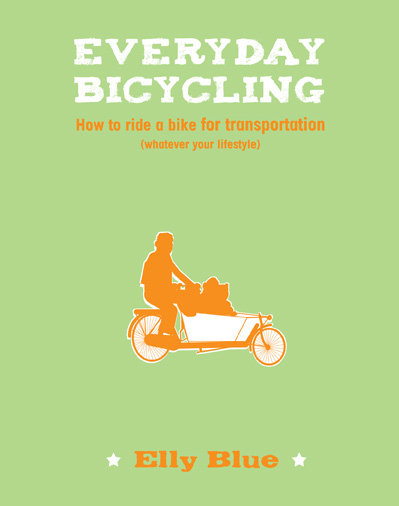
Labels: city cycling, elly blue, everyday bicycling, john pucker, ralph buehler
Saturday, April 21, 2012
Blacksburg Cycle Chic

Elly Blue of Taking the Lane is one of the other featured speakers. Besides writing Taking the Lane, Elly's writings appear in Grist, BikePortland, Momentum, and others.
Blacksburg Cycle Chic is a great way to kick off Bike Month. I just wish it were closer to Fairfax.
Labels: blacksburg, elly blue, fionnuala quinn
Monday, March 7, 2011
Saving the economy by ditching your car

In the many North American cities where two-wheeled transportation is taking off, a new bicycle economy is emerging. It's amazing how much money can stay in your community when it isn't being pumped into the gas tank, big insurance, and the auto market.
What will this new bicycle economy look like?
We don't have to guess. It's already emerging along urban, low-traffic bikeway networks nationwide. One thing is guaranteed: it includes a lot of new bike shops like this one on a bikeway in Baltimore -- one of five new bike shops to have opened in the last two years in that city. A 2008 study in Portland clocked bicycle-related industry alone as contributing $90 million to the local economy every year. Bicycle tourism is another huge boon to regions that can attract it -- in 2010, Wisconsin bragged of a yearly $1.5 billion bike economy [PDF].
Less obvious synergies abound as well. People who ride, just like people who drive, buy groceries, visit the doctor, need a new shirt sometimes, and enjoy dinner and a movie. They work. Their kids attend school. Despite the media attention given to mega-mileage supercommuters, for most people who depend on bikes for transportation, life works best with all these necessities in reasonable biking distance -- say, less than five miles -- from their home. Preferably along routes that don't include riding on highways or having to zip anxiously across them.
The rest of the article is a worth spending a few minutes to read.We don't have to guess. It's already emerging along urban, low-traffic bikeway networks nationwide. One thing is guaranteed: it includes a lot of new bike shops like this one on a bikeway in Baltimore -- one of five new bike shops to have opened in the last two years in that city. A 2008 study in Portland clocked bicycle-related industry alone as contributing $90 million to the local economy every year. Bicycle tourism is another huge boon to regions that can attract it -- in 2010, Wisconsin bragged of a yearly $1.5 billion bike economy [PDF].
Less obvious synergies abound as well. People who ride, just like people who drive, buy groceries, visit the doctor, need a new shirt sometimes, and enjoy dinner and a movie. They work. Their kids attend school. Despite the media attention given to mega-mileage supercommuters, for most people who depend on bikes for transportation, life works best with all these necessities in reasonable biking distance -- say, less than five miles -- from their home. Preferably along routes that don't include riding on highways or having to zip anxiously across them.
While it's much more difficult for us here in Fairfax to ditch the car, many of our trips are short and could easily be taken by car. With better bike facilities many others would be much more likely to reduce their car use by using bikes for these shorter trips. Multiple car families might have the option of getting rid of a car and saving thousands of dollars each year.
Labels: bicycle economy, elly blue, the wash cycle
Tuesday, November 23, 2010
We need real bike facilities for real bike transportation
A comment that we hear all too often is that we need to do something about the renegade cyclists. They don't obey traffic signals, they speed on crowded trails, they pass too close without warning. Unfortunately the criticism is often true.I just returned from a trip to Tucson, Arizona where there are bike facilities on almost all major roads. There's wayfinding signage, a good bike map, the right type of bike parking in most of the right locations. I'll write more about the trip later. One thing that was strikingly noticeable was that almost all cyclists obeyed the rules. They stopped at traffic lights, they were generally courteous, they wore lights at night. It was impressive. There were even buttons at cyclists' height at most intersections to allow them to trigger the light.
One conclusion you could draw is that if there are good bike facilities and cyclists are treated as a serious part of the transportation system, cyclists act appropriately. Conversely, when we have almost no bicycle facilities and the few we have are overcrowded with all types of users, bad things happen. As Ely Blue, a bike advocate from Portland, Oregon, notes in a recent article, "We need real bike paths for real bike transportation." In her discussion of recreational trails being used for bike transportation she describes the current situation on the W&OD Trail
It should be no surprise that these paths see a high collision and injury rate. A 2009 literature review of traffic safety studies looked at bicycle crashes and discovered that multi-use paths are more dangerous to ride on than even major roads.
Most attempts to address the danger focus on educating users to "share the path." This has been the gist of the most levelheaded responses to the tragic incident on the Katy Trail.
In effect, this is a way to blame the users. This becomes more clear when you brave the comment section on any story about the tragedy. The vitriolic finger-pointing starts immediately. Some blame bicyclists who ride fast and don't use their bells when passing. Others blame walkers and joggers who stop suddenly, don't hold their line, and let their kids and dogs run freely. Everyone blames people wearing headphones. Some simply blame everyone.
Meanwhile, few are looking to the real culprit: the increasingly common practice of building transportation facilities that cannot safely or comfortably carry the planned types of traffic, promoting them heavily, and then accepting easy credit for providing bike routes without having to take the political risks of encroaching on the vast amounts of roadways reserved for cars.
Shared trails are being heavily funded on the federal level, with politicians and advocates claiming major bike-friendliness points. This trend is likely to continue even post-election -- Rep. John Mica (R-Fla.) in line to be the new chair of the House Transportation Committee, is already boasting that his state has the most such multi-use paths in the country.
Even if they were not shared, many of these paths would not be adequate for bicycle traffic. Sight lines are not good, there is often no lane to pass slower riders, and the number of users keeps going up, up, and up. This is not the fault of people who ride bikes on them. In most cities, as in Dallas, options are slim. A congested, shared off-road path is often the lesser of two evils.
Politicians, planners, and advocates need to step up. And disgruntled trail users need to stop blaming each other and demand real bike paths. Often there's room in the same right of way to have a walking path and bike lanes in both directions, all wide enough. Many cities are experimenting with these, including Vancouver, B.C., Manhattan, and Seoul -- though you can still see an inevitable amount of user error in each of these photos.
But a few token separated paths, no matter how wide, will never be more than a political compromise. We need suitable places to go walk and jog and relax.
And if we are going to fill the rapidly growing demand for bicycle infrastructure, we need the real thing. Cramming bikes onto serene paths is like putting a superhighway through a schoolyard.
We already have a wide-ranging network of paved bike routes, where people can ride as fast and freely as they need to, have plenty of room to pass each other, and can expect to encounter pedestrians and joggers at clearly marked intersections. We just need to take back some of that space from cars. And for the sake of the paths, we need to do it soon.
What we need are real bicycle facilities for real bicycle transportation.Most attempts to address the danger focus on educating users to "share the path." This has been the gist of the most levelheaded responses to the tragic incident on the Katy Trail.
In effect, this is a way to blame the users. This becomes more clear when you brave the comment section on any story about the tragedy. The vitriolic finger-pointing starts immediately. Some blame bicyclists who ride fast and don't use their bells when passing. Others blame walkers and joggers who stop suddenly, don't hold their line, and let their kids and dogs run freely. Everyone blames people wearing headphones. Some simply blame everyone.
Meanwhile, few are looking to the real culprit: the increasingly common practice of building transportation facilities that cannot safely or comfortably carry the planned types of traffic, promoting them heavily, and then accepting easy credit for providing bike routes without having to take the political risks of encroaching on the vast amounts of roadways reserved for cars.
Shared trails are being heavily funded on the federal level, with politicians and advocates claiming major bike-friendliness points. This trend is likely to continue even post-election -- Rep. John Mica (R-Fla.) in line to be the new chair of the House Transportation Committee, is already boasting that his state has the most such multi-use paths in the country.
Even if they were not shared, many of these paths would not be adequate for bicycle traffic. Sight lines are not good, there is often no lane to pass slower riders, and the number of users keeps going up, up, and up. This is not the fault of people who ride bikes on them. In most cities, as in Dallas, options are slim. A congested, shared off-road path is often the lesser of two evils.
Politicians, planners, and advocates need to step up. And disgruntled trail users need to stop blaming each other and demand real bike paths. Often there's room in the same right of way to have a walking path and bike lanes in both directions, all wide enough. Many cities are experimenting with these, including Vancouver, B.C., Manhattan, and Seoul -- though you can still see an inevitable amount of user error in each of these photos.
But a few token separated paths, no matter how wide, will never be more than a political compromise. We need suitable places to go walk and jog and relax.
And if we are going to fill the rapidly growing demand for bicycle infrastructure, we need the real thing. Cramming bikes onto serene paths is like putting a superhighway through a schoolyard.
We already have a wide-ranging network of paved bike routes, where people can ride as fast and freely as they need to, have plenty of room to pass each other, and can expect to encounter pedestrians and joggers at clearly marked intersections. We just need to take back some of that space from cars. And for the sake of the paths, we need to do it soon.
Labels: elly blue, W and OD Trail


