
Mark Your Calendars: FABB September Meeting
 |
| Photo Courtesy of FCPS SRTS. |
Labels: bicycle education, mason district, safe routes to school, srts coordinator
Adult Bike Class This Saturday
 |
Labels: bicycle education, falls church
Essential Elements of a Bicycle-Friendly Community

>> Encouragement. Does the community promote and encourage cycling through events, campaigns, and incentives? Is there a bicycle club? A bicycle advisory committee? A bicycle advocacy organization? Does the community promote a bike-to-work day, week, or month?

>> Enforcement. Does the community have bicycle-friendly laws and policies in place? Does the community use enforcement to encourage cyclists to obey the laws and motorists to share the road? Do police patrol the bike trails? Are they plowed during the winter?
With these questions in mind, how is Fairfax doing and what can we be doing better?
Labels: advocacy, bicycle education, bicycle planning, law enforcement
DC second grade students receive bike safety education
All second graders in DC public schools now have the opportunity to learn to ride a bike. Starting this year physical education teachers will hold four 50-minute lessons on bike safely. District DOT and private donors purchased 1,000 bikes to be used in the classes.From the Washington Post article All D.C. public school students will learn to ride a bike in second grade:

The unit also reflects efforts across the country to make physical education classes more accessible and useful, with less focus on competitive sports and more attention to healthy lifestyles and fitness habits.
“This a lifelong skill,” said Miriam Kenyon, director of health and physical education for D.C. Public Schools. “It’s a way students can get to school and it’s also a way they can exercise with their family. It promotes independence, and it’s a good way to get around.”
Labels: bicycle education, dc, dc public schools, fairfax county public schools, learn to ride
Reston Century on W&OD Trail on Sunday
This weekend would be a great time to use the Fairfax County Interactive Bike Map to find a new bike route and explore the county. There are many on-road routes that are safe and provide a variety riding conditions. I often wonder why some of the faster cyclists insist on training on the W&OD Trail, especially on a busy weekend. If they want to ride fast, what better place than on the road.
I think many faster cyclists are afraid to ride on the road because they don't know how to do so safely, riding too far to the right and inviting cars to pass too close. According to Virginia law, if a lane is too narrow to share with a motorist, which describes most of our 11- and 12-foot lanes in Fairfax, than cyclists are not required to ride to the right. They should take the lane and force motorists to pass them properly, often requiring them to change lanes. This is much safer than hugging the curb. As of July, motorists can legally cross the double-yellow line to safely pass cyclists, allowing 3 feet when passing.
Today I saw a policeman riding a bike on Sunrise Valley Dr. in Reston in the gutter pan, riding much too far to the right. He then moved across two lanes to the left turn lane without signaling. Most bicycle police receive bicycle safety training so that officer should know better. Riding on the road safely is a skill that can be taught, and yet there is basically no bicycle education in Fairfax. Maybe that should change.
Labels: bicycle education, reston bike club, reston century
Bikeology - Middle and high school curriculum just published

"Bikeology is a ready-to-use bicycle-safety curriculum for physical education teachers and recreation specialists working with students in grades 6-12."
From Bike Portland:
In addition to key goals and skills for each unit, it includes both written activities like themed word searches and instructions for setting up physical activities like practice rides.
There's also a 34-page guide aimed at parents, with slightly more detailed information and advice.
It's certainly not a much of a marketing document.
"Bicycles are associated with more injuries and deaths than any other consumer product other than the automobile," the guide points out in a characteristic section urging every bicycle rider to use a helmet for every trip.
If I received the curriculum or parent's guide without having already decided that it was a good thing to get my students or children on bicycles, I'd be terrified: none of the documents has a single photo of people enjoying themselves, and it's left to instructor and students to come up with ways to convey the pleasures and advantages of biking in addition to the tasks, responsibilities and concerns.
That said, it's great to see the federal government making a serious effort to aid bike education at an age when we build our first transportation habits and too many girls, in particular, tend to abandon the activity. With Portland's own Safe Routes to School program expanding into middle schools this year, hopefully it'll be a useful tool.
Labels: bicycle education, bikeology
Bikeyface; Learning what it takes to bike more
I'm a big fan of Bikeyface and am catching up on some of the older illustrations. I love the series about people who want to start biking more, Small Steps: "It’s spring, and there are many more bikes on the road. Others want to start biking. But changing to any new mode of transportation is a big lifestyle change and takes time." Below is the summary image. Check out the others:"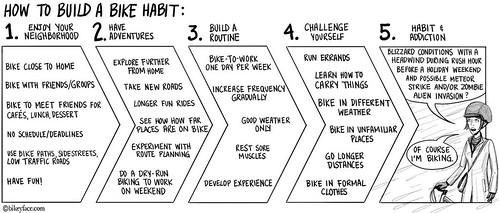
Labels: bicycle education, bikeyface
New bike videos from LAB
 The League of American Bicyclists recently released several new educational videos. Videos are organized in three broad categories, Better Bicycling, Riding Tips, and Bikes & Gears. They are based on the principles taught in the League's Traffic Skills 101 course, much of which is contained in the online version at bikeed.org.
While I haven't watched them all, the videos appear to be very well done. As a League Cycling Instructor I will likely use the videos in my classes in the future. From the League:
Labels: bicycle education, league cycling instructor, league of american bicyclists, video
Popularity of cycling in DC

When not traveling with my own bike I prefer to use CaBi once in the District. The SpotCycle mobile app is a great way to find stations and check availability of bikes. Unfortunately the apps wasn't working while I was riding Metro in the city. After arriving at the station I quickly found that there were no bikes available at the CaBi station near Foggy Bottom. According to the app, almost all nearby stations were empty. The one station with bikes was near Farragut North, but after walking there I discovered that the one bike at the station wasn't working.
I continued walking toward Dupont Circle in hopes of finding a bike. At M and 18th St the station had two bikes and three people wanting to rent. It was a race to see who could check out a bike first. Fortunately two more bikes arrived and there were bikes for everyone.
It was impressive to see how many people were using bikes last night to get around. DC is making great strides by providing new bike facilities all over town. The ride to Adams Morgan on Columbia Rd is now a little easier where the center turn lane was recently replaced with two 5-foot bike lanes. At the CaBi station near the WABA office I had a different problem; that station was full so I rode on to find an empty stall at a nearby station. Needless to say I was late for the meeting. I'll try to remember to check SpotCycle earlier next time.
See the GreaterGreaterWashington article What's better: More CaBi stations or bigger ones? on the challenges of making bikes available to everyone.
See another recent article on CaBi District homeless get help renting bikes.
Labels: bicycle education, capital bikeshare
Fairfax Co School Board modifies bike to school policy

Prior to their action, the school system did not have a clear policy regarding whether kids were allowed to bike to school. At some schools students were banned from biking:
It's critical that kids are taught how to safely walk and bike along our streets. We can't advocate in good faith to get more kids on bikes unless we ensure they receive safety education. We also think they will be better teen drivers if they learn the rules of the road at an early age.
The old policy was outdated and needed to be replaced. It didn't include bike safety and it referenced the school education officers. Here's the new policy:
The challenge now is how to find the resources to ensure that bike safety is taught in all 138 elementary schools. Safe Routes to School grants would help as would reinstatement of the School Education Officers, as was recommended by the School Health Advisory Committee last year.
Read more details about the policy changes. Now, about bikes being a prohibited student activity...
Labels: bicycle education, safe routes to school, walk and bike to school day
Bike safety in Fairfax

Markham suffered broken ribs, one of which punctured his lung.
“When the truck hit me, I was thrown up on the hood of the truck and then rolled off and landed in front of its front left tire,” Markham said. “The tire then rolled over me and remained on my back before it eventually backed up off of me.”
“I want to bring more bike safety awareness to the Northern Virginia area,” he said. “I have gotten involved with the Washington Biking Association and I want to get out there and speak to the public to educate both drivers and cyclists about sharing the road safely. No one should have to go through what I did.”
Labels: bicycle education, bike to work day, safety
Traffic Skills 101 class offered this week
Fairfax Co Adult and Community Education is offering a bicycle skills class this week, Cycling With Confidence! (LAB Traffic Skills 101). I will be teaching the class on Tuesday evening and all day Saturday at Chantilly High School on Stringfellow Road. Register online. To find out more about the classroom portion, visit the Traffic Skills 101 online course.Why should someone who has been riding a bicycle for many years want to take a bicycle skills course? Many people don't feel very safe riding with traffic, especially on busy main roads with higher speed limits. Through the use of "effective cycling" techniques, cyclists can learn to control traffic by using effective lane positioning techniques. With practice these techniques become second nature. They improves cyclists' visibility, both between and at intersections. Cyclists also learn how to avoid dangerous situations by practicing various skills such as the quick stop, rock dodge, and instant turn. These skills could save your life.
Labels: bicycle education, traffic skills 101
League Certified Instructor seminar coming to DC
WABA is sponsoring an LCI seminar to teach the teachers:Labels: bicycle education, lci seminar, traffic skills 101
Response to Post article on cyclist/motorist interaction
Earlier this week the Post published an article on bicyclist/motorist interactions (see our blog post on the article). FABB member Fionnuala Quinn responded to the article with a letter in today's Post on the need for better bicycle education:Comprehensive school bicycle curricula abound in Europe. I recently visited a Belgian program where 10-year-olds receive 30 hours of bicycle training during the school year. The students spend 20 hours riding in traffic, and they have to pass a four-kilometer road test. With this level of education, students are likely to grow up to have a much better understanding of bicycles in traffic, whether they are riding or driving.
The successful bicycling that can be seen in Europe is in part a reflection of a commitment to teaching the population how to share the right of way. We instruct our 16-year-olds on how to drive cars, so why not take a little time to learn about safe bicycling on our roads also? We would all benefit.
Fionnuala Quinn, Fairfax
The writer is a board member of Fairfax Advocates for Better Bicycling, but the views expressed are her own.
Update 5/26/2010: Why stereotype victims in cycling accidents? is the title of another letter to the Post. The title says it all:
The article alleges that "the majority of the half-dozen cyclist deaths [in Fairfax] in the past five years have involved Latino immigrants riding to or from work in the dark" — soft numbers but do the math. Perhaps three or four people of Latin descent were killed in cycling accidents in the past five years. This is far from a cultural revelation.
It is fair to assume that workers who must bicycle to and from work in the dark are from a lower economic strata, but to link cycling deaths to ethnicity is absurd. Were any statistics kept describing the cultural identities of the vehicle drivers who caused these deaths? Perhaps a majority were white Anglo-Saxon Protestants. Equally absurd.
Jim Wilson, Warrenton
Labels: bicycle education
Bicycle skills classes
 We've started teaching Traffic Skills 101 courses in Fairfax this year. For many years Allen Muchnick has taught this course in Northern Virginia, mostly inside the Beltway. The course was developed by the League of American Bicyclists with the goal of teaching bicyclists to ride safely in traffic.
Vehicular cycling or effective cycling "is the practice of driving bicycles on roads in a manner that is visible, predictable, and in accordance with the principles for driving a vehicle in traffic." The concepts are embodied by the statement that "Cyclists fare best when they act and are treated as drivers of vehicles."
 Through the use of vehicular cycling techniques, cyclists can learn to control traffic by lane positioning. When a lane is too narrow to share, "taking the lane" is the best, safest strategy. With practice this technique becomes second nature. It improves cyclists' visibility, both between and at intersections. Cyclists also learn how to avoid dangerous situations by practicing skills such as the quick stop, rock dodge, and instant turn. These skills will become second nature and could save your life.
Most people in the U.S. have never been taught how to ride properly in traffic. They may have learned how to "ride" a bike, basically how to propel the bike forward without falling. This has nothing to do with learning proper riding techniques or understanding the principles of traffic law. Is it any wonder that many people don't really know how to ride in traffic?
The classes are 9 hours over two or three days. The first class was held at the Vienna Community Center, with classroom instruction for three hours on a Thursday, and classroom instruction, parking lot drills, and the road test on Saturday. Three completed the course. The second class was held at the Reston Community Center on two Saturdays. Four students completed the course and received certificates.
Two additional spring courses are scheduled for April 22 & 24 and May 13 & 15 in Herndon through Fairfax County's Adult and Community Education program.
Labels: bicycle education, traffic skills 101
Virginia Beach bicyclists ride in honor of fallen cyclist
 On April 19 Daniel Hersh was struck and killed while riding on Shore Drive in Virginia Beach. No charges have been filed against the motorist, who was overtaking the cyclist when he was hit. The crash is still being investigated. As noted by Virginia Bicycling Federation, "Under Virginia law, a driver of an overtaking vehicle must wait until it is safe to pass, then pass with at least 2 feet of clearance. Bicycles are vehicles under Virginia law."
On Sunday over 100 bicyclist rode in honor of the fallen cyclist:
On a sunny spring day, the group took to some of the city's biggest, busiest roads - Virginia Beach Boulevard, Independence Boulevard and Shore Drive - to demonstrate that bicyclists ride on the same roads and under the same rules as cars and they expect the same justice, according to ride organizer Wes Cheney.
Virginia Bicycling Federation has established the Daniel Wayne Hersh Memorial Fund dedicated to bicycling education.
Labels: bicycle education, virginia beach, virginia bicycling federation


