Tuesday, January 13, 2015
Federal traffic forecasting modified to reflect decline in driving
A recent blog post on BikePortland discusses how federal traffic forecasters have finally modified future traffic estimates that reflect the decline in driving nationwide: After a decade of less driving, federal forecast shifts to match reality. Traffic forecasts are important since they are used by state and local transportation departments to justify massive road projects, and to reject bike projects. |
| U.S. VMT (in trillions) as tracked by FHWA's Travel Volume Trends ("Actual") and as projected by U.S. DOT's C&P reports (by year reports are dated). (Chart: SSTI) |
For travel forecasters around the country, it’s been a very confusing decade, probably best summed up by this chart showing year after year of incorrect traffic projections from USDOT’s annual Conditions and Performance report, which aggregates projections from metro areas around the country.
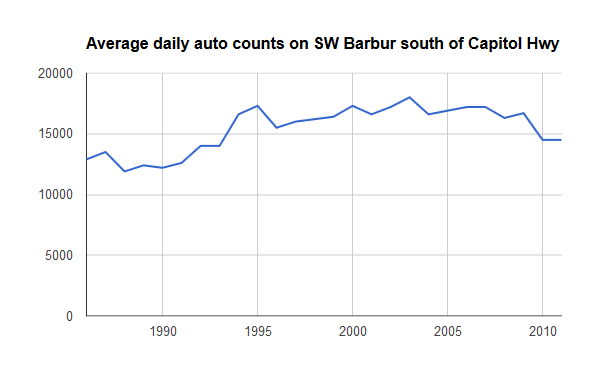
How much traffic will increase is a debate that affects us in very practical ways here in Portland, where (for example) the Oregon Department of Transportation has cited future traffic increases as a reason not to improve bike lanes on Southwest Barbur even though its own data shows that auto traffic on Barbur peaked in 2003.
Andy Cotugno, the transportation planning director for regional planning agency Metro, said Wednesday that his organization won’t be affected by the federal change, in part because his team’s projections already reflect the plateau in miles driven per person.
“We’ve scaled our transportation plans down to be more realistic,” said Cotugno.
Cotugno often circulates a chart showing that in the Portland metro area, driving rates per person peaked in 1996, eight years before they did the same nationally.
But Cotugno said he worries that state DOTs and other agencies are too eager to circulate overestimates for future travel demand as a way to justify the need for more money.
Labels: fhwa, traffic forecast, vmt
Saturday, March 22, 2014
New approach to transportation project planning from McAuliffe administration
The new Virginia deputy secretary of transportation, Nick Donohue, recently told to the Commonwealth Transportation Board that the McAuliffe administration will use a different approach to transportation planning. In the past planners have overestimated how many miles people will travel by car and underestimated the demand for alternative modes of transportation.This is good news for bicyclists and supporters of smart growth. It's hopeful that the new approach will rely less on planning major road projects and have a better understanding the importance of encouraging growth around transit. Below is an extract from an article that appears on Bacon's Rebellion, Virginia’s Behind-the-Scenes Transportation Planning Revolution:
Yesterday, Donohue calmly dismantled core assumptions that have long underpinned transportation planning in Virginia. Under the aegis of VTrans, previous governors have forecast long-term travel demand and estimated the transportation funding needs based on that forecast. Traditionally, the VTrans product has emphasized vast funding shortfalls, in the tens of billions of dollars, over the following 20 years. One thing the McAuliffe administration wants to do, said Donohue, is to ask, “What did we say before, and did it happen?”
As it turns out, federal forecasts were pretty bad, he said, showing the following chart showing how they consistently overshot the mark:

Virginia’s forecasts suffered from similar biases in the past, he said. Now VTrans will begin considering non-traditional indicators of travel demand. For example, Donohue said, the number of 20- to 34-year-olds not getting their licenses has edged up from about 10% in 2000 to 15% today. A National Association of Realtors (NAR) survey found that a majority of respondents indicated a preference to live in walkable communities with mixed-use development. More families are moving into multifamily housing. And a NAR analysis found that the sales prices of houses located near transit out-performed other housing by 41% over the last five years.
As it turns out, federal forecasts were pretty bad, he said, showing the following chart showing how they consistently overshot the mark:
Virginia’s forecasts suffered from similar biases in the past, he said. Now VTrans will begin considering non-traditional indicators of travel demand. For example, Donohue said, the number of 20- to 34-year-olds not getting their licenses has edged up from about 10% in 2000 to 15% today. A National Association of Realtors (NAR) survey found that a majority of respondents indicated a preference to live in walkable communities with mixed-use development. More families are moving into multifamily housing. And a NAR analysis found that the sales prices of houses located near transit out-performed other housing by 41% over the last five years.
Labels: mcauliffe, nick donohue, vdot, vehicle miles traveled, vmt