
Tuesday, March 1, 2016
Vienna Metrorail Bicycle Access Study meeting Wed. March 2
Do you want better bike access to the Vienna Metro Station? To you want to be able to use the I-66 parallel trail to reach the station? This is your chance to learn about plans for improving bike access as part of the Vienna Metrorail Bicycle Access Study at a meeting tomorrow night., 6-8pm at Oakton HS.From Fairfax County Dept. of Transportation:
 |
| Green: Sutton Rd Pink: Virginia Center Blvd/Country Creek Rd Blue: Nutley St |
Community Meeting Scheduled for March 2, 2016
A kick-off meeting will be held on Wednesday, March 2, 6 – 8 p.m., at Oakton High School cafeteria (2900 Sutton Road, Vienna, Va., 22181) to introduce the public to the project. The meeting will consist of a presentation and a breakout session to gather feedback on existing conditions, areas of concern, ideas for improvements and overall goals for bicycling in this area.
Saturday, December 7, 2013
Detection of bicycles at signalized intersections
Not long ago we received the following message from a cyclist regarding detection of bicycles at two intersections adjacent to the Vienna Metro station. We sent the query on to VDOT and received a very thorough and informative response that we thought worth publishing.Many of us have had problems with traffic signals not changing because our bicycle was not detected by in-ground sensors. The following information explains some of the intricacies of vehicle detection at signalized intersections. Thanks to Randy Dittberner for taking the time to respond.
Here's the message we received:

As you may know, the signal at Vaden and Saintsbury is new--so new that VDOT has not yet accepted it into our system. It is still being operated by the developer constructing the MetroWest project. Questions or comments about this signal can be directed to the VDOT permittee, Jeff Edelman (571-283-1978 /jeff.edelman@pultegroup.com), or agent Jeff Oetjen (703-801-5848 / joetjen@comcast.net).
The signal at Virginia Center has been in place for many years and is operated by VDOT. This signal is actuated using inductive loop detectors, the most common detection technology VDOT uses at its signals.
Unlike most signals, the Virginia Center signal operates in a mode we call “uncoordinated.” This means that it doesn’t use a fixed cycle time, but rather is free to serve conflicting movements at any time, once the signal detects a vehicle or pedestrian waiting on the side street and a gap in traffic on the major street. The average wait time for vehicles on the side street should rarely exceed about 40 seconds--much shorter than coordinated signals. (A longer wait may occur, for instance, if pedestrians have pushed the button to activate both crossings of Virginia Center during the same signal cycle.)
If a cyclist finds that the signal is not detecting him or her without autos on the same approach, it is useful to know how VDOT typically installs its loop detectors:
In general, VDOT uses the same loop detector design at all traffic signals: a rectangle 40 feet long (parallel to the direction of traffic) and 6 feet wide. The edge of the detector typically extends past the stop bar by 5 feet, which leaves 35 feet of detection zone approaching the stop bar. A detector is typically centered in each traffic lane on the side street. This link shows a typical VDOT loop detector installation, but usually loops are installed before the final pavement surface and are hence invisible.
VDOT normally uses a detector called a “quadrupole” loop, which has its greatest sensitivity along the centerline of the loop (parallel to traffic). Cyclists have the best chance of being detected when they ride in the exact center of the traffic lane at some point while they’re within 35 feet of the stop bar.
Caveats: Sometimes loops are shortened or lengthened based on site conditions, and it can be difficult to find the center of a loop on a sharp curve, because loops are always rectangular even when the road is curved. Some intersections use a different kind of detection other than loops for various reasons, and the advice about loops may not apply at these locations.
If all else fails, this signal is also equipped with pedestrian pushbuttons on both sides of Vaden. While it can be an annoyance for cyclists to use the pushbutton, at least the option is available in this case.
By coincidence, I cycle through the Virginia Center intersection frequently, and I have found that it is remarkably effective at detecting cyclists. I have not found the same to be true at the Saintsbury intersection. No loop detector can detect every bicycle, particularly those without a considerable amount of metal in the frame.
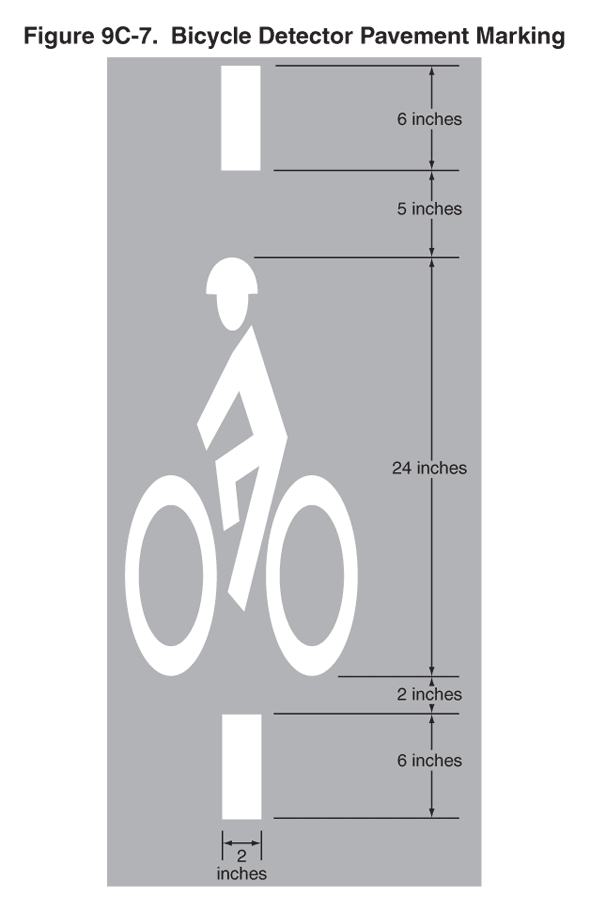
VDOT is undertaking a pilot project to improve detection of cyclists at signals, and the Virginia Center intersection is planned for inclusion in the project because of its above-average ability to detect cyclists. The project may include some bike detector signs and pavement markings, but specific details are still under development.
You may also recall that VDOT worked closely with Dave Gibson, the FHWA researcher who authored the document at the link Mr. Schrag sent, when we installed the loop detectors and associated markings in the bike lanes on Soapstone Dr. at South Lakes Dr.
Randy Dittberner, P.E., PTOE
Regional Traffic Engineer
Virginia Department of Transportation
Northern Region
4975 Alliance Drive, Fairfax, VA, 22030
The signal at Virginia Center has been in place for many years and is operated by VDOT. This signal is actuated using inductive loop detectors, the most common detection technology VDOT uses at its signals.
Unlike most signals, the Virginia Center signal operates in a mode we call “uncoordinated.” This means that it doesn’t use a fixed cycle time, but rather is free to serve conflicting movements at any time, once the signal detects a vehicle or pedestrian waiting on the side street and a gap in traffic on the major street. The average wait time for vehicles on the side street should rarely exceed about 40 seconds--much shorter than coordinated signals. (A longer wait may occur, for instance, if pedestrians have pushed the button to activate both crossings of Virginia Center during the same signal cycle.)
If a cyclist finds that the signal is not detecting him or her without autos on the same approach, it is useful to know how VDOT typically installs its loop detectors:
In general, VDOT uses the same loop detector design at all traffic signals: a rectangle 40 feet long (parallel to the direction of traffic) and 6 feet wide. The edge of the detector typically extends past the stop bar by 5 feet, which leaves 35 feet of detection zone approaching the stop bar. A detector is typically centered in each traffic lane on the side street. This link shows a typical VDOT loop detector installation, but usually loops are installed before the final pavement surface and are hence invisible.
VDOT normally uses a detector called a “quadrupole” loop, which has its greatest sensitivity along the centerline of the loop (parallel to traffic). Cyclists have the best chance of being detected when they ride in the exact center of the traffic lane at some point while they’re within 35 feet of the stop bar.
Caveats: Sometimes loops are shortened or lengthened based on site conditions, and it can be difficult to find the center of a loop on a sharp curve, because loops are always rectangular even when the road is curved. Some intersections use a different kind of detection other than loops for various reasons, and the advice about loops may not apply at these locations.
If all else fails, this signal is also equipped with pedestrian pushbuttons on both sides of Vaden. While it can be an annoyance for cyclists to use the pushbutton, at least the option is available in this case.
 |
| Image: FHWA |
VDOT is undertaking a pilot project to improve detection of cyclists at signals, and the Virginia Center intersection is planned for inclusion in the project because of its above-average ability to detect cyclists. The project may include some bike detector signs and pavement markings, but specific details are still under development.
You may also recall that VDOT worked closely with Dave Gibson, the FHWA researcher who authored the document at the link Mr. Schrag sent, when we installed the loop detectors and associated markings in the bike lanes on Soapstone Dr. at South Lakes Dr.
Randy Dittberner, P.E., PTOE
Regional Traffic Engineer
Virginia Department of Transportation
Northern Region
4975 Alliance Drive, Fairfax, VA, 22030
Labels: inductive loops, Randy Dittberner, traffic signal, vienna metro
Wednesday, July 10, 2013
FABB Social Ride this Saturday - Merrifield/Vienna tour - Note 10am start time

Date: 7/13/2013 at 10 am. In the case of rain we will notify registered riders via email and a message on the FABB home page.
About the Ride:
- Riders will depart at 10am from Angelica Theater in the Mosaic District. The ride is a combination of neighborhood streets, and multi-use trails. A section of the Cross County Trail is unpaved.
- The ride is a loop of about 12 miles
- This is a no-drop social ride at a 10-12 mph pace. There will be stops along the way.
- The ride is for adult WABA Members. Children 14-18 may participate if they are accompanied by an adult WABA member.
- FABB will provide Ride Marshals for the ride
- Your bike
- Helmet (required no exceptions)
- Lock to secure your bike at the cafe
- WABA membership number
- Water and a snack, sunscreen
- Cash for purchasing an optional lunch at Lost Dog Cafe near Dunn Loring Metro station
The Angelika Theater is located in the new Mosaic District near the intersection of Gallows Road and Lee Highway in Merrifield. Angelika Theater is located at 2911 District Ave, Fairfax , VA 22031. It's a short ride from the Dunn Loring Metro station. Take Prosperity Ave to left on Merrilee Dr which turns into Eskridge Rd after crossing Lee Hwy. Turn left on Strawberry Lane. Angelika Theater is on your right. If you cannot bike to the start, there is free parking nearby.
Optional Lunch/Brunch:
Please indicate whether you plan to stop at Lost Dog Cafe after the ride.
Optional Lunch/Brunch:
Please indicate whether you plan to stop at Lost Dog Cafe after the ride.
Labels: dunn loring, fabb social ride, merrifield, mosaic district, vienna, vienna metro
Thursday, May 17, 2012
College Park "Bike 'N Ride" station opens

Yesterday WMATA opened their first Bike & Ride station at the College Park-U of MD Metro Station. Users gain access to the secure enclosed area using a BikeLink™ card that can be purchased online. Inside the facility are U racks and an experimental double-decker rack. Bikes are locked up once parked at a rack.
BikeLink™ cards cost $20 and have $20 of rental value stored on them. The cost of using the space is very reasonable, 5 cents per hour 8 am - midnight, 2 cents/hour all other times. With the lower overnight fees it's feasible to leave your bike overnight.
Check out this video featuring Justin Antos of WMATA's Office of Long Range Planning as he demonstrates using the facility:
Labels: bike and ride, bikelink, college park, justin antos, vienna metro, wmata
Friday, April 20, 2012
Bike events this weekend
- Fairfax to Vienna Metro Ride - Leaving at 9:30am Saturday from Oasis Bike Works, the ride will be a chance to follow part of the proposed bike route from GMU to Vienna Metro. RSVP.
- Vienna Bike Rack Ribbon-Cutting - 11am-1pm Saturday at Maple Ave Shopping Center, 311 E Maple Ave, Vienna. Win a Breezer bike donated by bikes@vienna. See the event flier for a list of other giveaways.
- Cancelled - Wolftrap ES Bike Rodeo on Sunday. Due to predictions of rain, the bike rodeo is rescheduled to Sunday, May 6 from 12-2pm.
See the FABB Events page for other upcoming events.
Labels: town of vienna, vienna metro, wolftrap elementary school


